
Silicone vs Latex Swim Caps: Which One Actually Belongs On Your Head?
A complete, no-fluff comparison covering comfort, durability, allergies, hydrodynamics, and price — so you can stop guessing and pick the cap that fits your swim.
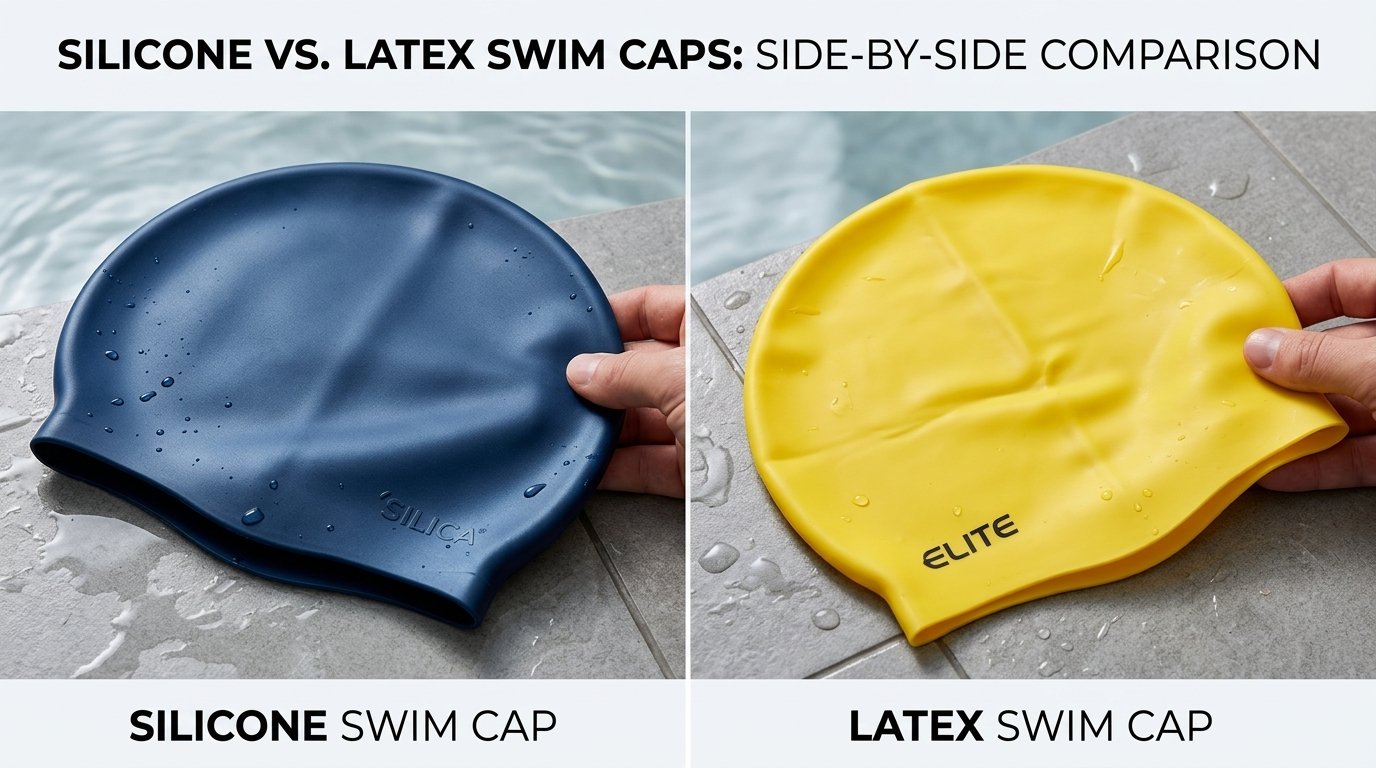
If you’ve stood in the swim-gear aisle staring at a wall of caps, you’ve probably noticed they’re not all made the same way. Some feel like a soft balloon stretched over your scalp. Others feel thicker, sturdier, almost rubbery in a different sense. That difference usually comes down to one thing: silicone versus latex. It sounds like a minor manufacturing detail, but the material your cap is made from actually changes how it fits, how long it lasts, how it feels against your skin, and even how fast you move through the water.
This guide breaks down silicone and latex swim caps in plain language, covering everything from comfort and allergies to racing performance and price. Whether you’re a triathlete training for open water, a parent buying a first cap for your kid, or someone who just wants to keep their hair dry during lap swim, you’ll find the answer here. If you haven’t picked a cap style yet, our guide to the best swim caps is a good companion piece to this comparison.
Most swimmers never think twice about cap material until something goes wrong — a rash appears after a swim meet, a cap tears mid-workout, or hair keeps getting soaked despite wearing “protection.” These small frustrations are almost always traceable back to a material mismatch: the wrong cap for the wrong swimmer, the wrong environment, or the wrong frequency of use. A recreational swimmer doing three laps a week has completely different needs than a triathlete training in open water year-round, and a cap that’s perfect for one can be a poor fit for the other.
Rather than telling you “silicone is better” or “latex is better” and leaving it there, this guide walks through every angle that actually matters in real swimming conditions: how each material behaves when wet, how it holds up over weeks and months of use, what it does to sensitive skin, how it affects your speed, and what it actually costs once you account for how often you’ll need to replace it. By the end, you should be able to look at your own swimming habits and know exactly which material fits your situation — no guesswork required.
A Brief History of Swim Cap Materials
Swim caps have been around in one form or another since the early 1900s, when swimmers first started wearing rubberized fabric caps to keep long hair out of the way in competition. Natural rubber, or latex, was really the only viable option for decades, simply because synthetic alternatives hadn’t been developed yet. Early latex caps were thick, uncomfortable, and prone to cracking, but they did the job well enough that the design stuck around largely unchanged for most of the twentieth century.
Silicone entered the swimming world much later, gaining real traction in the 1990s and early 2000s as synthetic polymer manufacturing became cheaper and more refined. Swimmers and coaches quickly noticed that silicone caps lasted longer, caused fewer skin reactions, and could be molded into more advanced shapes than latex ever could. Competitive swimming federations didn’t mandate one material over the other, which meant the two have coexisted ever since, each carving out its own niche depending on the swimmer’s priorities.
Today, the split is fairly predictable: recreational swimmers, swim schools, triathletes, and open water athletes lean heavily toward silicone, while a subset of competitive racers and budget-conscious teams still reach for latex. Understanding how that split happened helps explain why both materials are still widely available instead of one having fully replaced the other.
What Is a Silicone Swim Cap?
Silicone swim caps are made from a synthetic polymer that’s soft, elastic, and slightly thicker than latex. It’s the same general family of material used in kitchenware, medical devices, and baby bottle nipples, which should tell you something about how gentle it tends to be on skin. Silicone caps have become the default choice for most recreational and competitive swimmers over the last couple of decades, largely because they solve two problems that plagued older latex designs: they don’t smell like rubber, and they rarely trigger allergic reactions.
Because silicone is more elastic and holds its shape better, manufacturers can mold it into thicker, more structured caps without sacrificing stretch. That’s why you’ll see silicone caps with textured surfaces, domed shapes for long hair, or dual-layer construction for open water swimmers who need extra warmth. If you swim with long hair, it’s worth pairing this material knowledge with our dedicated best swim caps for long hair roundup.
Silicone also behaves more predictably across a wide range of temperatures. Cold pool decks, hot summer sun, and warm indoor facilities all put some amount of stress on cap material, and silicone tends to shrug this off better than natural rubber does. It doesn’t stiffen up in the cold or turn tacky in the heat nearly as noticeably, which is part of why silicone caps feel consistent no matter where or when you’re swimming.
There’s also a visual and branding advantage that’s easy to overlook: silicone holds printed logos, patterns, and vibrant colors far better than latex. This is why nearly every swim team, club, and event that wants a custom-printed cap defaults to silicone. The smoother surface takes ink and dye more evenly, and the print doesn’t crack or peel nearly as fast as it would on a thinner, more flexible latex surface.
What Is a Latex Swim Cap?
Latex swim caps are made from natural rubber, harvested from rubber trees and processed into a thin, stretchy sheet. Latex was the original swim cap material long before silicone became mainstream, and it’s still around today mostly because it’s cheap to produce and extremely thin. That thinness is actually latex’s biggest selling point: a well-fitted latex cap hugs the skull so closely that it creates almost no drag, which is why you still see it at some competitive swim meets and triathlons.
The tradeoff is that natural rubber degrades faster than silicone, especially when exposed to chlorine, sunlight, and oils from skin and hair products. Latex caps also carry a well-known allergy risk for people with latex sensitivities, which silicone completely avoids. Despite these downsides, plenty of racers still prefer latex for single-use, race-day performance where cost and disposability aren’t a concern.
Latex’s biggest practical advantage beyond thinness is how quickly it can be mass-produced. Because the dipping process is simpler and faster than silicone molding, manufacturers can churn out large batches of latex caps at a fraction of the cost. This is exactly why swim clubs, school programs, and community pools often hand out latex caps by the dozen — they’re inexpensive enough to treat as a consumable rather than a piece of gear you’re expected to maintain for months.
It’s worth noting that not all latex caps are created equal. Higher-grade latex caps, often labeled as “molded latex” rather than “dipped latex,” use a slightly thicker and more consistent rubber layer that holds up noticeably better than the cheapest bargain-bin versions. If you do choose latex, spending a little more on a reputable swim brand rather than a generic multipack will usually get you a cap that lasts longer and fits more evenly.
Material and Manufacturing Differences
The manufacturing process explains a lot of the performance differences you’ll notice while swimming. Latex is produced by dipping a mold into liquid rubber repeatedly to build up a thin, even layer, then curing it with heat. This keeps the material extremely light and thin, usually well under half a millimeter, but it also means the finished product is more sensitive to environmental stress like UV exposure and ozone in the air.
Silicone, on the other hand, is typically injection-molded or compression-molded, which allows manufacturers to control thickness more precisely and add texture or ribbing for grip. This process produces a denser, more durable cap that resists tearing and doesn’t degrade nearly as quickly when left in a swim bag or gym locker. It’s a reasonable rule of thumb that the more “premium” a swim cap brand feels, the more likely it’s using a refined silicone blend rather than raw latex.
Another manufacturing distinction worth understanding is seam construction. Many silicone caps are molded as a single, seamless piece, which removes one of the most common failure points on any swim cap: the seam line where two pieces of material are glued or bonded together. Latex caps, especially cheaper ones, more frequently rely on a bonded seam around the crown, and that seam is often the first place a latex cap starts to fail after weeks of stretching and rinsing.
This is also why silicone caps can support more elaborate design features like raised grip ridges along the hairline, or a slightly thicker rim around the ear openings to reduce pressure points. Latex’s thinness limits how much structural detail can be built into the mold without compromising its stretch, which is part of why most latex caps look and feel fairly similar to one another regardless of brand.
| Property | Silicone | Latex |
|---|---|---|
| Base Material | Synthetic polymer | Natural rubber |
| Typical Thickness | 0.4mm–0.6mm | 0.15mm–0.3mm |
| Odor | Virtually none | Noticeable rubber smell |
| UV Resistance | Good | Poor |
| Elasticity Recovery | Excellent, long-term | Good, degrades over time |

Check Price on Amazon
Comfort and Fit
Comfort is where these two materials really diverge. Silicone’s extra thickness gives it a softer, more cushioned feel against the scalp, and it doesn’t pinch or pull hair as aggressively when you’re putting it on. It also warms up to body temperature quickly, so it doesn’t feel cold and rubbery the way latex sometimes does straight out of a swim bag.
Latex, being thinner and less forgiving, tends to grip the head more tightly. Some swimmers love this because it feels more secure and streamlined, especially during flip turns. Others find it uncomfortably snug, particularly around the ears and temples, and it’s more prone to catching stray hairs during removal. If pulling hair while putting on a cap is a recurring problem for you, our guide on how to put a swim cap on without pulling hair has techniques that work for both materials, though they matter more with latex.
Ear comfort is another area where the two materials diverge in ways swimmers don’t always expect. Because latex caps sit so close to the skull, they can create noticeable pressure directly on the ear cartilage during longer sessions, which some swimmers describe as a dull ache after 45 minutes to an hour in the water. Silicone’s extra give tends to distribute that pressure more evenly, which is one reason distance swimmers and open water athletes, who spend far longer in the water per session than a typical sprinter, tend to prefer it.
Temperature sensitivity at the moment of application also plays a role in perceived comfort. Silicone caps stored at room temperature go on smoothly without much resistance, while latex caps that have been sitting in a cold gym bag or car can feel stiff and unyielding for the first minute of wear before they warm up and loosen slightly. For swimmers who train early in the morning in unheated facilities, that initial stiffness is a small but real annoyance that silicone simply doesn’t have.
Silicone Comfort Wins
- Softer against skin and scalp
- Less prone to pinching at the hairline
- Warms to body temperature fast
Latex Comfort Drawbacks
- Tighter, more restrictive grip
- Can feel cold when first applied
- Higher chance of catching hair
Durability and Lifespan
If you swim regularly, durability is arguably the biggest practical difference between these two materials. A well-cared-for silicone cap can realistically last a year or more of consistent use, sometimes multiple years for casual swimmers. The material resists chlorine breakdown reasonably well and doesn’t get brittle as quickly.
Latex caps, by contrast, are often treated as semi-disposable. Many competitive swimmers buy latex caps in bulk specifically because they expect to replace them every few weeks or even after a single race, as constant stretching, sun exposure, and chlorine cause the rubber to thin out and eventually tear. If longevity matters more to you than race-day marginal gains, silicone is the more economical long-term choice even though it costs more upfront.
Chlorine exposure deserves special attention here because it’s the single biggest factor separating how these two materials age. Chlorine is chemically harsher on natural rubber than on synthetic silicone, gradually breaking down the proteins and structure of latex in a process that shows up as thinning, discoloration, and eventually pinhole tears. Swimmers who train in heavily chlorinated pools, or who swim almost daily, will notice latex degrading noticeably faster than swimmers who only hit the pool once or twice a week.
Sun exposure compounds the problem for anyone who swims outdoors. UV rays accelerate the same breakdown process that chlorine causes, which is why a latex cap left drying on a poolside chair in direct sun will visibly age faster than one dried in shade or indoors. Silicone isn’t completely immune to UV damage either, but it holds up considerably longer under the same conditions, which matters a lot for outdoor lap swimmers and triathletes training through the summer months.
Hair Protection
Neither material is fully waterproof over a long swim session, but silicone generally does a better job of keeping hair dry for shorter workouts because of its thicker, denser structure. For swimmers with long or thick hair, the fit is just as important as the material — a poorly sized cap of either type will let water seep in around the edges regardless of what it’s made from.
If hair protection is your top priority, look specifically for silicone caps designed with extra volume or a domed crown, which are built to accommodate buns, braids, or thick ponytails without stretching thin at the seams. Our breakdown of the best swim caps for long hair covers several silicone options built exactly for this purpose.
Swimmers with chemically treated, color-treated, or chemically relaxed hair often have an additional reason to favor silicone: chlorine exposure is one of the biggest culprits behind color fading and dryness, and a thicker, better-sealed cap simply lets less chlorinated water reach the hair shaft over the course of a swim. While no cap will keep hair bone-dry through a full workout, a properly fitted domed silicone cap can meaningfully cut down on how saturated hair gets by the end of a session.
For swimmers who want maximum hair protection, doubling up with two caps — often a thin silicone or latex cap underneath and a slightly larger silicone cap on top — is a common trick used by swimmers with very long or very thick hair. The bottom layer creates a tighter seal against the scalp while the top layer adds bulk and an extra barrier against water intrusion at the edges.
Allergies and Skin Sensitivity
This is the single most important health consideration in the silicone versus latex debate. Latex, being a natural rubber product, contains proteins that can trigger allergic reactions ranging from mild skin irritation to more serious responses in people with a diagnosed latex allergy. Swimmers, coaches, and parents of young swimmers should always ask about material before assuming a cap is safe, especially at swim schools or shared team environments where caps might be shared or borrowed.
Silicone caps carry essentially none of this risk. The material is inert, hypoallergenic, and widely used in medical settings for exactly this reason. If you have any history of skin sensitivity, eczema, or rubber allergies, silicone isn’t just the more comfortable option, it’s the safer one.
Latex allergies exist on a spectrum. Some people experience only mild, localized contact dermatitis — redness, itching, or small bumps where the cap touches skin — while others can have more systemic reactions that require medical attention. Because reaction severity can increase with repeated exposure over time, someone who tolerated latex caps fine as a child can develop a more pronounced sensitivity as an adult, especially with frequent, prolonged use. This is one of the reasons many swim schools and aquatic therapy programs have shifted to silicone-only policies over the past decade.
If you’re unsure whether you have a latex sensitivity, a simple precaution is to do a short test swim of 10 to 15 minutes with a latex cap and watch for any redness, itching, or irritation along the hairline or ears in the hours afterward. If nothing shows up, occasional latex use is likely fine; if you notice any reaction at all, it’s worth switching to silicone permanently rather than risking a stronger reaction on a future swim.
Thermal Insulation and Open Water Use
Open water swimmers care about a factor that pool swimmers rarely think about: heat retention. Because silicone is thicker and denser, it traps a thin layer of warmth against the scalp more effectively than latex, which matters a lot in cold lakes, rivers, or ocean swims. Some silicone caps are specifically marketed as thermal or dual-layer caps for open water and cold-weather triathlon starts.
Latex simply doesn’t offer the same insulation because it’s so thin. Swimmers doing open water events, especially in cooler months, typically favor silicone or neoprene over latex for this reason alone. If open water is your main focus, our guide to the best swim caps for open water goes deeper into thermal and visibility features you’ll want to look for.
Heat loss through the head is disproportionately significant in cold water because the scalp has a rich blood supply close to the surface of the skin. This is why open water race organizers frequently require or strongly recommend thicker caps, and why some swimmers wear two caps stacked together in particularly cold conditions. A silicone cap alone won’t make cold water swimming feel warm, but it noticeably reduces how quickly core body heat escapes through the head compared to a thin latex cap.
Visibility is a related but separate benefit worth mentioning. Because silicone holds bright, saturated colors better than latex and is more commonly available in high-visibility orange, pink, or yellow, open water swimmers and triathletes often choose silicone caps specifically to be more visible to safety kayakers, boats, and other swimmers, independent of any thermal benefit.
Hydrodynamics and Competitive Racing
For pure speed, latex still has a slight edge in some scenarios. Its thinness allows it to hug the skull almost seamlessly, reducing the tiny bit of drag that a thicker silicone cap can create. This is why you’ll occasionally see competitive swimmers layer a thin latex cap under a silicone or textured racing cap on meet day, chasing every fraction of a second.
That said, high-end silicone racing caps have closed most of this gap in recent years through thinner, more precisely molded designs built specifically for competition. For the vast majority of swimmers — even competitive ones training and racing at a club or collegiate level — the drag difference between a quality silicone racing cap and latex is negligible compared to factors like stroke technique and body position.
The double-cap strategy deserves a closer look since it’s often misunderstood by newer swimmers. The idea is to wear a thin latex cap directly against the scalp, then stretch a silicone cap over the top. The latex layer smooths down any stray hairs and creates a tighter base, while the silicone layer adds a slick, low-friction outer surface and helps keep goggle straps securely in place. This combination is common at the elite level but is entirely unnecessary for recreational swimmers, where the marginal drag reduction has no meaningful impact on lap times.
It’s also worth remembering that cap material is a very small piece of the overall drag equation. Swimsuit fabric, body position, and even how a swimmer enters the water off the wall during a flip turn have a far larger effect on speed than the difference between a silicone and latex cap. Swimmers chasing performance gains are usually better served focusing on stroke mechanics first and treating cap material as a secondary, marginal consideration.
Stretch, Sizing, and Ease of Use
Latex stretches more aggressively but also snaps back into a tighter shape, which is why some swimmers find it harder to put on despite it technically being more elastic. Silicone stretches with a bit more resistance but tends to be more forgiving and predictable, making it easier for beginners, kids, or anyone with limited hand strength to pull on without a struggle.
Sizing charts vary by brand for both materials, but as a general pattern, silicone caps run slightly larger due to their thickness, while latex caps rely on their stretch to accommodate different head sizes. If you’re buying for a child or a first-time swimmer, our roundup of best swimming goggles for kids pairs well with cap shopping, since kids’ swim gear sizing tends to follow similar comfort-first logic.
Most brands sell caps in one-size-fits-most, with a smaller subset offering separate youth or “long hair” sizing. Because latex has less structural memory, a poorly sized latex cap will either feel dangerously tight around the temples or slip off entirely, with very little middle ground. Silicone’s thicker walls give it a bit more tolerance, meaning a cap that’s slightly off from your exact head measurement is more likely to still feel wearable rather than uncomfortable.
New swimmers often struggle more with latex simply because it takes practice to stretch the opening wide enough without pinching fingers or hair in the process. If you or your child are new to swim caps in general, starting with silicone is usually the gentler learning curve, and you can always graduate to latex later for racing purposes once you’re comfortable with the basic technique.
Cost Comparison
Latex caps are almost always cheaper per unit, often sold in multi-packs for the price of a single silicone cap. This makes sense given how much less material and processing goes into each one. Swim teams and schools frequently buy latex caps in bulk for exactly this reason, treating them as a low-cost, semi-disposable item.
Silicone caps cost more individually, but because they last significantly longer, the cost per month of use often ends up lower over time. If you swim several times a week year-round, a single well-made silicone cap can end up cheaper in the long run than replacing latex caps every few weeks.
To put this in concrete terms: if a silicone cap costs roughly three times as much as a latex cap but lasts six to eight times longer, the silicone option wins on cost per swim once you do the math over a full year. The exception is anyone who swims rarely — for occasional or seasonal swimmers, a cheap latex cap that sits unused for weeks at a time won’t degrade meaningfully faster just from sitting in a drawer, making the lower upfront cost the more sensible choice.
Team and club purchasing decisions often come down to this same math applied at scale. A swim team outfitting fifty swimmers with silicone caps faces a much larger upfront invoice than the same order in latex, even though the long-term per-swimmer cost may end up comparable or even favor silicone once replacement frequency is factored in across a full season.
| Factor | Silicone | Latex |
|---|---|---|
| Typical Unit Price | Higher | Lower |
| Average Lifespan | Months to years | Weeks to a few months |
| Best For | Regular, long-term use | Occasional or race-day use |

Check Price on Amazon
Environmental Impact
Latex has one genuine environmental advantage: it’s derived from a renewable, natural source and biodegrades far more readily than synthetic silicone. Rubber tree harvesting, when done responsibly, is a lower-impact raw material process compared to petrochemical-based silicone production.
However, because silicone caps last so much longer, they generate less waste per year of actual use, even though the material itself doesn’t break down as easily once discarded. Neither option is perfectly sustainable, but swimmers who prioritize reducing waste often lean toward buying fewer, longer-lasting silicone caps rather than repeatedly replacing latex ones.
Rubber tree cultivation for latex production does carry its own environmental footprint, including land use and, in some regions, deforestation concerns tied to expanding plantations. Silicone production relies on silica, a widely abundant raw material, but the manufacturing process is more energy-intensive and produces byproducts that don’t break down naturally in the environment.
For swimmers who want to minimize environmental impact regardless of which material they choose, the most effective single habit is simply extending the life of whatever cap you own — rinsing it properly, storing it out of direct sunlight, and avoiding unnecessary early replacement. A cap that lasts twice as long, silicone or latex, cuts its effective environmental footprint roughly in half.
Care and Maintenance
Both materials benefit from the same basic care routine: rinse with fresh water after every swim, avoid leaving the cap balled up while wet, and store it away from direct heat or sunlight. Talcum powder or a light dusting of cornstarch can help prevent latex from sticking to itself in storage, a trick that’s been used by swimmers for decades.
Avoid folding silicone caps too tightly for long periods, since sharp creases can eventually weaken the material at the fold line. Neither cap should be left in a hot car or gym bag for extended periods, since heat accelerates degradation in both natural rubber and synthetic silicone alike.
Chemical exposure beyond chlorine is another factor swimmers often overlook. Sunscreen, hair oils, and certain leave-in conditioners can leave a residue on cap material that accelerates breakdown over time, particularly on latex. A quick rinse with mild soap and water once every week or two, followed by a thorough freshwater rinse, helps remove this buildup without damaging either material.
When it comes to storage, a flat or loosely rolled position is better than a tightly folded one for both materials, though it matters more for latex given its thinness. Many swimmers keep a small mesh bag specifically for their cap and goggles so the cap isn’t crushed under heavier gear like fins or a kickboard, which can create permanent indentations or weak spots over time.
Do
- Rinse with fresh water after every use
- Air dry fully before storing
- Keep away from direct sunlight and heat
Avoid
- Leaving it wet and balled up in a bag
- Storing near chlorine tablets or chemicals
- Repeated tight folding at the same crease
Common Buying Mistakes to Avoid
The most frequent mistake swimmers make is buying based on price alone without considering how often they’ll actually use the cap. A three-pack of latex caps looks like a bargain until you realize you’re replacing them every month anyway, at which point a single durable silicone cap would have cost less over the same stretch of time.
Another common misstep is ignoring fit in favor of material. A high-quality silicone cap that’s the wrong size will still leak, pinch, or slip, while a well-fitted latex cap can outperform an ill-fitting silicone one in terms of comfort. Always check a brand’s sizing guide, and when in doubt, size up rather than down, especially for long or thick hair.
Shoppers also frequently overlook the seam and edge quality of a cap before buying, especially online where you can’t physically inspect the product first. Reading reviews specifically for comments about tearing, seam separation, or edge rolling can save you from a frustrating first swim. Cheap, unbranded caps of either material are far more likely to have inconsistent seam quality than caps from established swim brands.
Finally, don’t assume all “latex-free” labeling means silicone. Some caps are made from neoprene, PU-coated fabric, or other synthetic rubbers that behave differently from both silicone and latex. If you have a specific need — like a documented latex allergy — always confirm the exact material listed in the product description rather than relying on marketing language alone.
How Cap Choice Changes by Swim Type
Lap swimming and fitness swimmers: For anyone swimming a few times a week for fitness, silicone is almost always the better fit. It’s comfortable enough for frequent use, lasts long enough that you’re not constantly replacing it, and doesn’t carry any allergy risk for casual swimmers who haven’t been tested for latex sensitivity.
Competitive pool racing: Sprinters and racers chasing marginal performance gains may still reach for a thin latex cap on meet day, sometimes layered under a silicone racing cap. Training sessions, however, are usually done in silicone simply because it holds up better across daily practice.
Open water and triathlon: Silicone is the clear favorite here thanks to better thermal insulation, stronger UV resistance, and higher visibility color options. Many open water events explicitly recommend or supply silicone caps in bright colors for safety visibility, and our best swim caps for open water guide breaks down specific models built for these conditions.
Swim schools and children’s lessons: Silicone dominates this category almost entirely, largely because of its lower allergy risk and easier on-off handling for small hands and sensitive scalps. Programs working with large groups of children also benefit from silicone’s durability, since caps get handled roughly and need to survive repeated use across many lessons.
Budget-conscious team programs: Latex remains popular here because of its low per-unit cost, particularly for teams that provide caps to every swimmer and expect turnover throughout a season. As long as swimmers are monitored for any signs of skin irritation, latex can be a practical, cost-effective choice at this scale.
Which Should You Choose?
If you swim frequently, have any history of skin sensitivity, or want a cap that will last through months of regular training, silicone is the clear choice. It’s more comfortable, safer for sensitive skin, holds up better over time, and offers meaningfully better insulation for open water or cold-pool swimming.
If you’re racing competitively and chasing every fraction of a second, swimming occasionally, or outfitting a large team on a budget, latex still has a place. Its thinness and low cost make it a reasonable choice for race day or short-term, high-volume use where replacement cost isn’t a major concern.
Not sure where a cap fits into your broader gear setup? Pair this decision with our guides on best swimming goggles and best one-piece swimsuits to build out a complete, comfortable kit for the pool or open water.
A simple way to decide quickly: think about how many times you’ll wear the cap before it either wears out or stops being comfortable. If that number is in the dozens or hundreds of swims, silicone’s higher upfront cost pays for itself. If you’re looking at a single event, a handful of practices, or a one-off gift for someone trying swimming for the first time, latex’s lower price and disposability make more sense.
It’s also perfectly reasonable to own both. Many regular swimmers keep a silicone cap for daily training and a latex cap tucked in their bag for race day or as a backup if their primary cap tears mid-season. Having both on hand means you’re never caught without the right tool for the specific swim in front of you.
Full Comparison Table
| Category | Silicone | Latex |
|---|---|---|
| Comfort | Softer, more forgiving | Tighter, more restrictive |
| Durability | Months to years | Weeks to a few months |
| Allergy Risk | Very low | Higher, contains natural rubber proteins |
| Thermal Insulation | Better | Minimal |
| Drag / Hydrodynamics | Very good, slightly thicker | Excellent, ultra-thin |
| Price per Unit | Higher | Lower |
| Best Use Case | Daily training, open water, sensitive skin | Race day, budget team use |
| Odor | Minimal | Noticeable rubber smell |
Frequently Asked Questions
Which lasts longer, silicone or latex swim caps?
Silicone lasts significantly longer, often a year or more with proper care, while latex caps typically need replacing every few weeks to a couple of months with regular use.
Are silicone swim caps better for sensitive skin?
Yes. Silicone is hypoallergenic and doesn’t contain the natural rubber proteins found in latex that can trigger allergic reactions or skin irritation.
Do latex swim caps smell?
Many latex caps have a noticeable rubber odor, especially when new, while silicone caps are largely odorless straight out of the package.
Which swim cap is faster in the water?
Latex caps are thinner and can offer a very slight edge in reduced drag, but modern silicone racing caps have closed most of that performance gap.
Can I be allergic to a silicone swim cap?
True silicone allergies are extremely rare. Most reactions attributed to swim caps are actually caused by latex rather than silicone.
Do swim caps keep hair completely dry?
No swim cap is fully waterproof for long sessions, but a well-fitted silicone cap generally keeps hair drier for longer than a thinner latex cap.
Are latex swim caps cheaper than silicone?
Yes, latex caps are usually less expensive per unit, though silicone can be more cost-effective over time due to its longer lifespan.
Which cap is better for open water swimming?
Silicone is generally preferred for open water because it offers better thermal insulation and holds up better against sun and saltwater exposure.
How do I stop my swim cap from pulling my hair?
Choose a slightly larger size, moisten the cap before putting it on, and pull it on evenly from the forehead back. Our step-by-step guide covers techniques for both materials.
Can kids wear latex swim caps safely?
Most kids can, but because latex allergies are more common than people expect, many swim schools default to silicone caps for young swimmers as a precaution.
Do silicone caps fade or discolor over time?
Silicone is more resistant to fading than latex, but prolonged sun and chlorine exposure can still dull the color of any cap over time.
Should competitive swimmers wear silicone or latex on race day?
It depends on the event and personal preference. Many competitive swimmers use latex for its thin, low-drag profile on race day and silicone for daily training.
Final Verdict: Silicone or Latex?
There’s no single right answer here, but for most swimmers, silicone earns its higher price tag through better comfort, durability, and safety for sensitive skin. Latex still holds a legitimate place for race-day performance, team budgets, and swimmers who don’t mind replacing their cap often. The best move is to match the material to how and how often you actually swim, rather than defaulting to whatever’s cheapest on the shelf.
Whichever material you land on, remember that fit and care matter just as much as the material itself. A properly sized cap, rinsed and dried correctly after every swim, will always outperform a poorly fitted one regardless of whether it’s silicone or latex. Take the extra minute to measure your head, read the sizing chart, and treat your cap with a bit of care, and it will reward you with a better, drier, more comfortable swim every time you get in the water.
Ready to gear up? Browse our full roundup of the best swim caps to compare top-rated silicone and latex options side by side.
Shop Swim Caps on Amazon