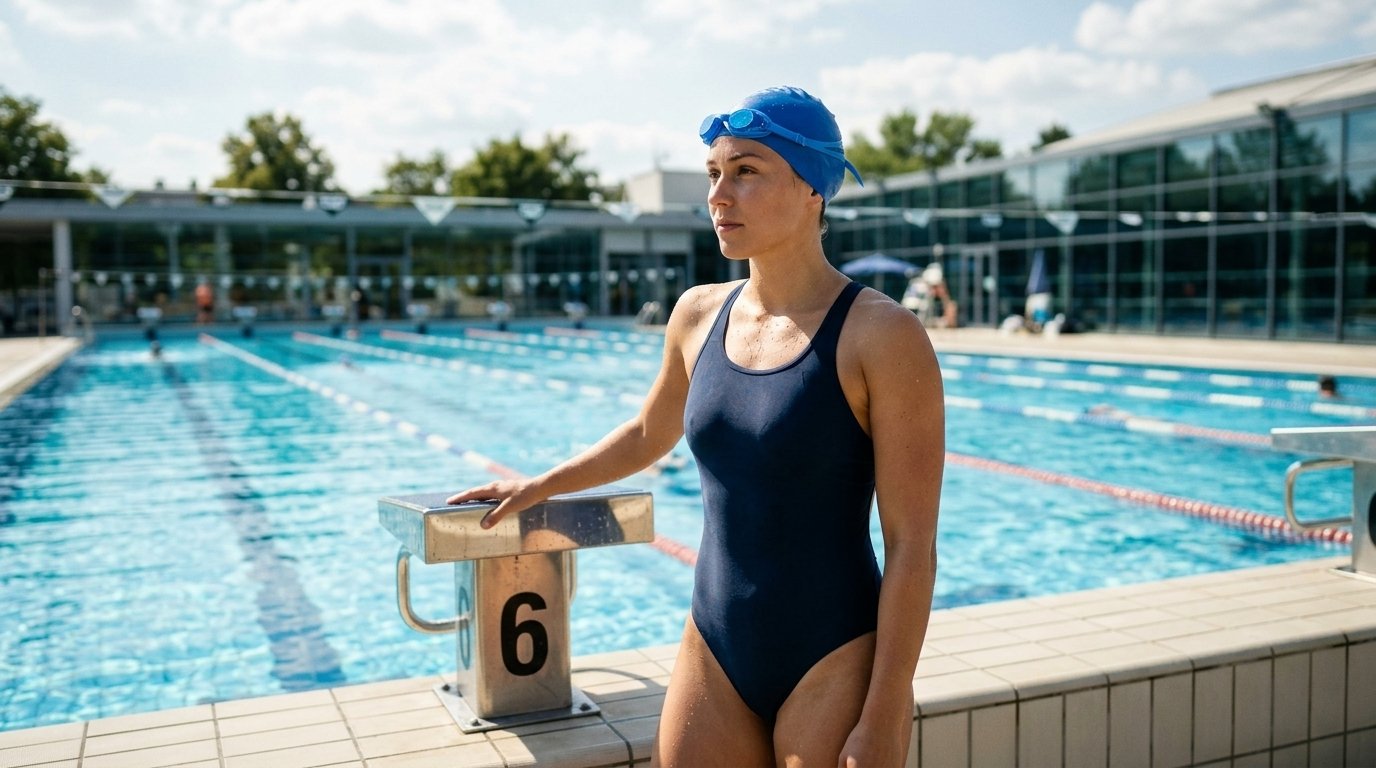
How to Put on a Swim Cap Without Pulling Hair
A slow, deliberate technique — plus prep tricks, cap choices, and troubleshooting — so your swim cap glides on instead of yanking every strand on the way.
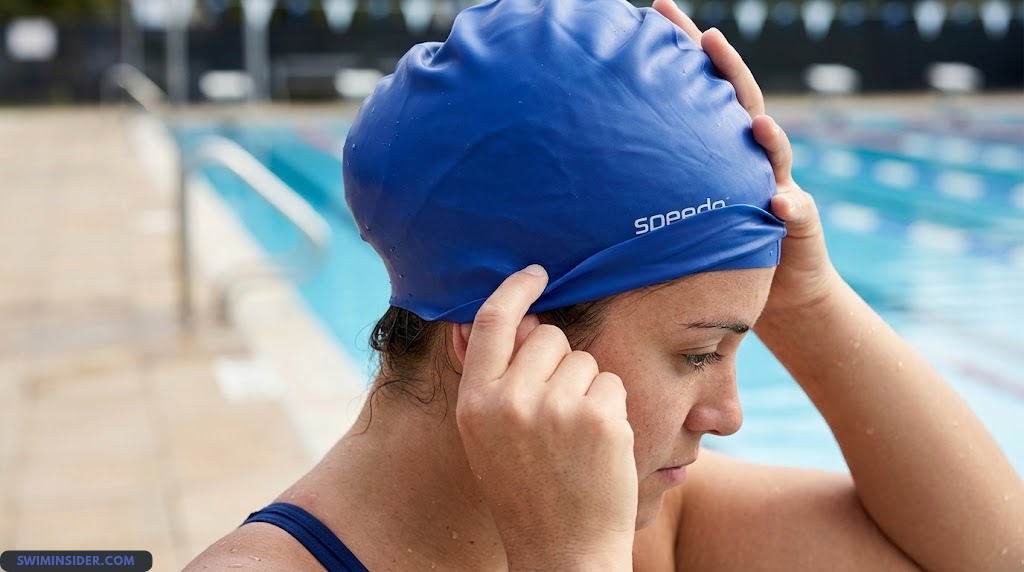
Why Swim Caps Pull Hair in the First Place
Almost everyone who has ever pulled on a swim cap has felt it: the sharp little tug right at the hairline, or the sensation of a whole section of hair getting trapped and yanked as the cap seats itself. It is one of the most common complaints among new swimmers, triathletes, and anyone with hair longer than a buzz cut, and it is also one of the easiest problems to solve once you understand what is actually happening.
A swim cap is essentially a stretchy membrane that needs to compress a three-dimensional head shape into a smooth, low-drag sphere. To do that, the material has to grip. That grip is what keeps water out and the cap in place during flip turns and open water swells, but it is also exactly what catches loose strands, flyaways, and the edges of a ponytail if you rush the process. Hair pulling almost never comes from a flawed cap design on its own — it comes from friction against dry hair, from stretching the cap unevenly, or from dragging the material across your scalp instead of rolling it into place.
Understanding this mechanism changes how you approach putting the cap on. Instead of treating it as a quick yank-and-go motion, you start treating it as a controlled, two-handed process that respects how the material behaves. The rest of this guide walks through exactly how to do that, step by step, with a version for long hair, a version for short hair, and troubleshooting for stubborn cases like thick curls or fine flyaway strands.
It also helps to remember that a swim cap is a piece of sports equipment, not a fashion accessory you toss on the way out the door. Competitive swimmers, coaches, and triathlon veterans treat cap application as a small, repeatable ritual, the same way they treat goggle adjustment or a pre-race stretch. That mindset shift alone prevents a lot of pulling, because rushing is the number one behavioral cause of a painful cap experience. Give yourself the extra thirty seconds. Your scalp, and your hair, will thank you.
This guide is built around a single idea: pulling is a mechanical problem with a mechanical solution. There is no special hair type that is doomed to a painful cap experience forever, and there is no cap on the market that is entirely immune to bad technique. What follows is a complete system — preparation, a core no-pull method, variations for different hair lengths and textures, material comparisons, a troubleshooting checklist, and a buying guide for anyone who wants to upgrade their equipment rather than just their technique.

Start With a Cap That’s Actually Built for This
A soft, seamless silicone cap makes every step below dramatically easier. See our full breakdown of the best swim caps before you shop.
Shop Silicone Swim Caps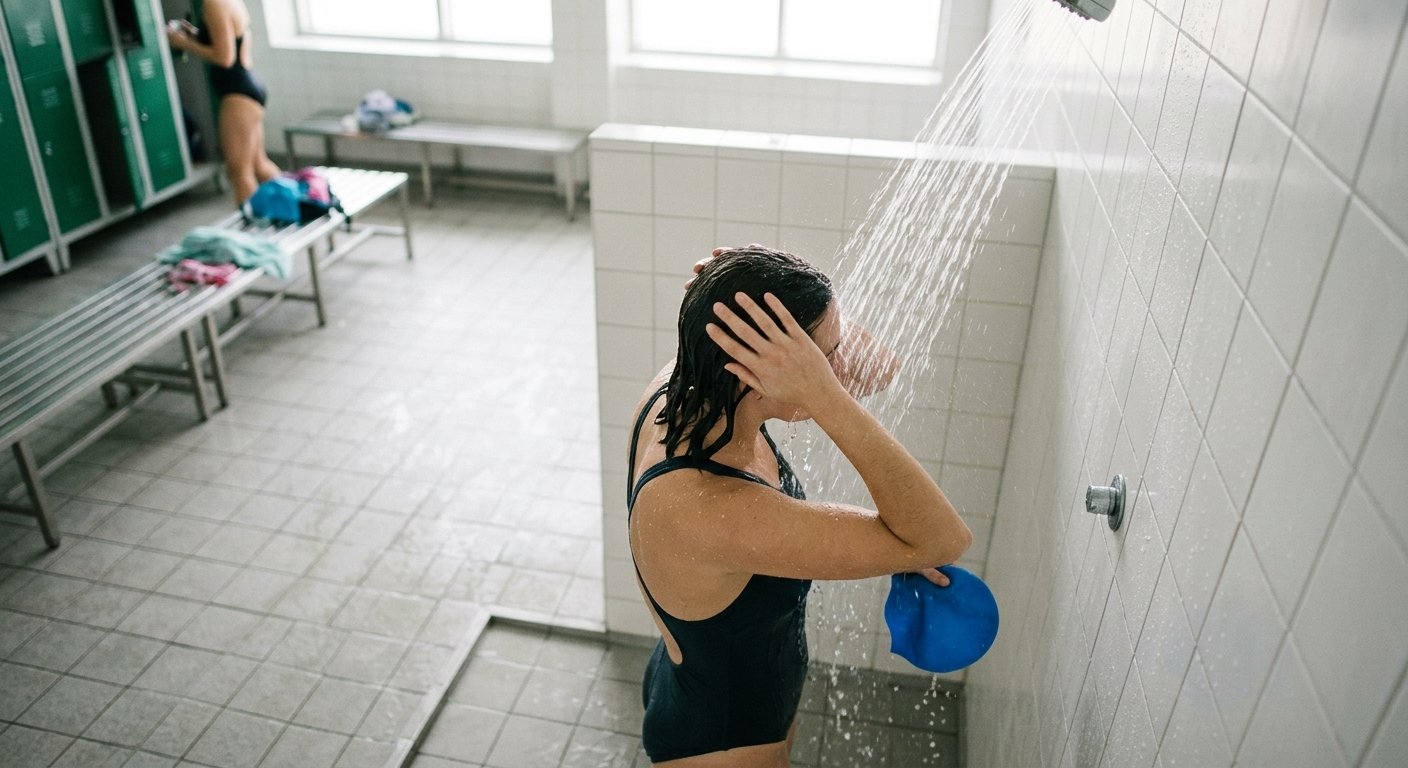
Before You Start: Preparing Your Hair and Cap
Most hair-pulling incidents are decided before the cap ever touches your head. A few minutes of preparation solves more problems than any application technique can fix after the fact.
Wet your hair first
Dry hair has far more friction against silicone or latex than wet hair does. Rinsing your hair under the pool shower or a sink for even thirty seconds noticeably reduces the drag between individual strands and the cap’s interior surface. This is the single highest-impact change you can make, and competitive swimmers do it out of habit for exactly this reason.
Gather it flat, not bunched
A high, loose bun creates a lump that the cap has to stretch dramatically over, which multiplies the pulling force on the hair at the base of that bun. A low, flat gather — closer to the nape of the neck or smoothed straight back — gives the cap a much more even surface to roll over.
Warm the cap slightly
Cold silicone and latex are stiffer and grippier. Running the cap under warm water for a few seconds, or simply holding it in your hands for a minute before putting it on, makes the material more pliable and less prone to snagging.
Trim your nails
It sounds unrelated, but long or sharp fingernails frequently catch both hair and the cap material itself during application, causing exactly the kind of uneven tension that leads to pulling.
| Prep Step | Why It Helps | Time Needed |
|---|---|---|
| Wet hair | Reduces friction between strands and cap material | 30 seconds |
| Flatten hair against scalp | Removes bumps the cap must stretch over | 1 minute |
| Warm the cap | Makes silicone/latex more pliable | 30–60 seconds |
| Trim nails | Prevents snagging on cap and hair | One-time |
| Apply light conditioner (optional) | Extra slip for thick or curly hair | 1 minute |
Set up your space before you reach for the cap
A surprising number of hair-pulling incidents happen simply because someone is rushing between the locker room and the pool deck, trying to put a cap on while walking, half-distracted by a conversation or a phone. Give yourself a stationary moment. Stand in front of a mirror if one is available, or at minimum stop moving. A cap applied while standing still, with both hands free and your full attention on the process, goes on more evenly than one applied on the move.
Consider the order of operations
If you also wear goggles, put your cap on before your goggles, not after. Trying to slide a cap over goggle straps adds an extra layer of friction and often drags the goggle strap into your hair, creating a second source of pulling that has nothing to do with the cap’s material at all. The correct order is: prep hair, apply cap, then goggles, then tuck any final strap or hair edges under the back of the cap.
Step-by-Step: The No-Pull Method
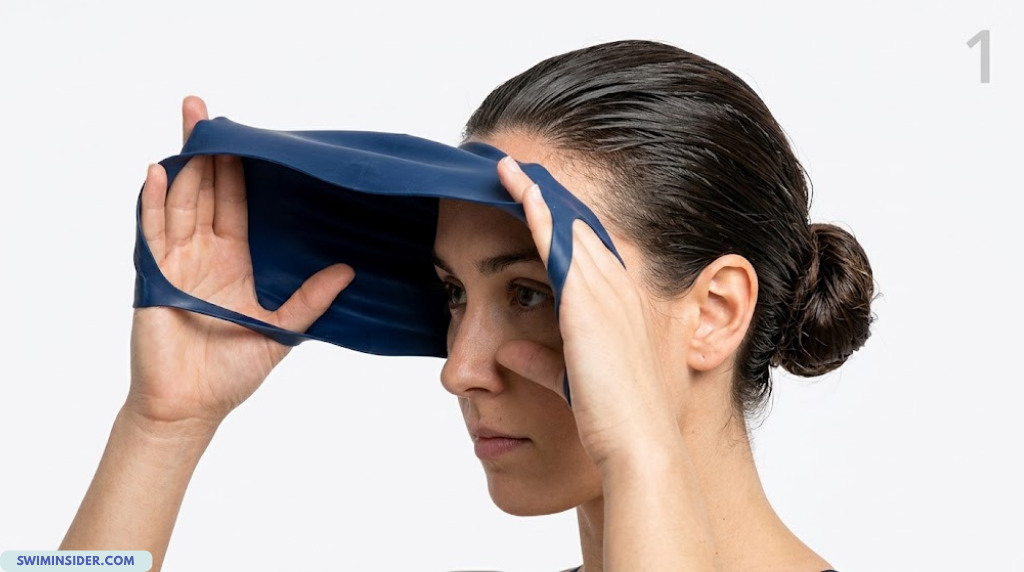
This is the core technique. It works for most hair lengths and cap materials, and it is the method competitive swim coaches teach to new team members. Read through it once, then follow along the next time you’re poolside.
Step 1: Ball Up the Cap
Instead of holding the cap open with two hands stretched wide, scrunch it into a loose ball shape, similar to how you would hold a beanie before putting it on. This concentrates the stretch you’ll need into a smaller, more controllable opening.
Step 2: Place It on Your Forehead First
Position the front edge of the cap on your forehead, roughly an inch or two above your eyebrows, before it touches any hair at all. This anchors the cap at a fixed, hairless point, so all the stretching that follows moves backward and downward instead of sideways across loose strands.
Step 3: Stretch Wide With Both Hands
With the cap anchored on your forehead, use both hands to grip the back edge and pull it wide — think of opening a rubber band, not a single point of tension. A wider stretch means less material contact per square inch as it moves over your hair.
Step 4: Roll, Don’t Pull, Over the Crown
This is the step most people get wrong. Instead of yanking the cap straight back over your whole head in one motion, roll it slowly over the crown, letting the material make contact with a narrow band of hair at a time rather than dragging across the whole surface at once.
Step 5: Tuck Loose Edges With Flat Fingers
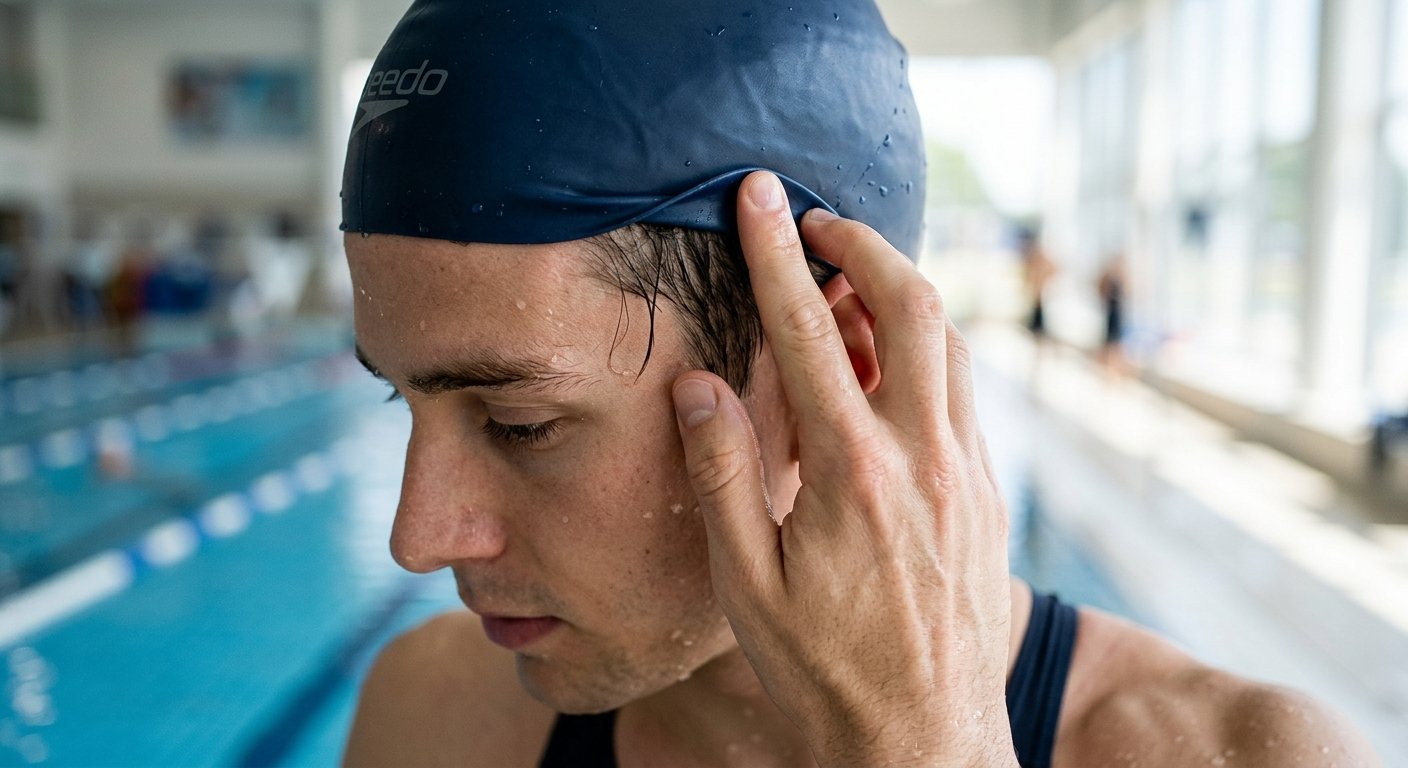
Once the cap is mostly seated, small sections of hair often poke out near the ears or the nape of the neck. Use flat fingers — not fingertips or nails — to tuck these sections underneath the cap’s edge, sliding along the scalp rather than pinching and pulling.
Step 6: Smooth From Center Outward
Finish by placing both palms flat on the crown of the cap and smoothing outward and downward toward the ears, pressing out any air pockets and settling the material evenly. This final pass redistributes tension so no single area of hair is bearing extra pull.
Once you’ve done this a handful of times, the whole sequence takes under thirty seconds and becomes second nature. The key mental shift is treating the cap as something you roll into place with two hands working together, not something you stretch once and drop onto your head.
It’s worth practicing this sequence a few times away from the pool deck, especially if you’re new to swimming or transitioning to a new cap material. Stand in front of a mirror, work through each step slowly, and pay attention to exactly where you feel resistance. Most swimmers find that after three or four deliberate run-throughs, the motion becomes automatic, and the pace naturally speeds up without sacrificing the gentleness that keeps hair from catching. From that point on, cap application becomes a non-event, something you do without thinking, rather than a small daily source of dread before getting in the water.

Long Hair? Pair Your Cap With the Right Accessories
See our dedicated guide to the best swim caps for long hair for extra-roomy options built for buns and braids.
Shop Long-Hair Swim Caps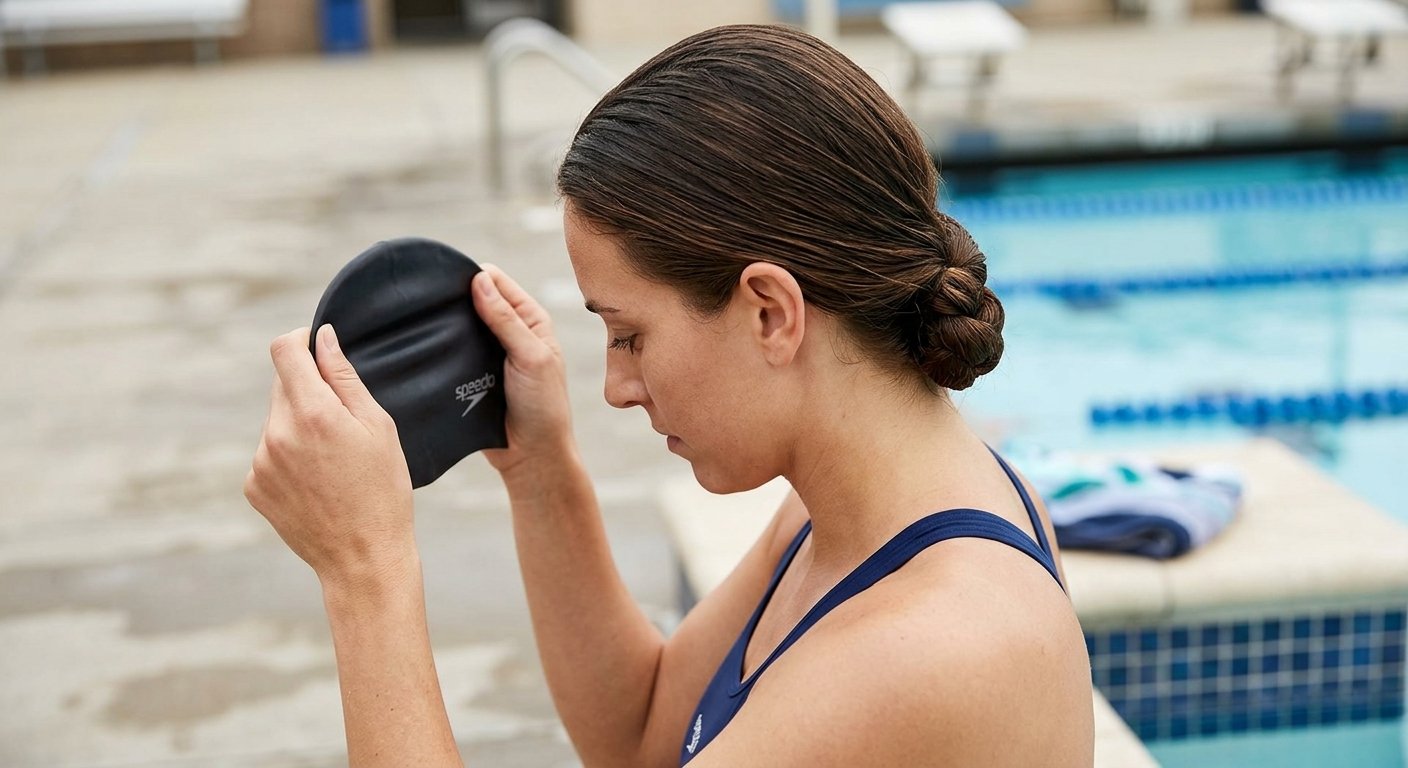
Method for Long or Thick Hair
Long hair needs a slightly different approach because volume, not just friction, is the main obstacle. A cap that has to compress a large bun or a thick braid is under far more tension at that one point, which is exactly where pulling tends to happen.
Braid or twist first
A single low braid or twist, positioned close to the base of the skull, distributes hair much more evenly than a loose ponytail. Avoid a high bun; the higher the bun sits, the more the cap has to stretch vertically to cover it, and that stretch translates directly into pulling force.
Split the volume, if needed
For very thick or long hair, some swimmers find it easier to divide hair into two low twists rather than one thick braid, then flatten both against the head before capping. This spreads the bulk out horizontally instead of concentrating it in one lump.
Consider a silicone liner cap
Many long-haired swimmers use two caps: a thin, stretchy liner cap first to smooth hair down, followed by a structured racing or fitness cap on top. This is covered in more detail in the double-capping section below, and it remains one of the most reliable ways to avoid pulling with long or heavy hair.
Method for Short Hair
Short hair is generally easier to cap without pulling, but it comes with its own quirks. Very short hair, especially buzz cuts or pixie cuts, has less surface area for the cap to grip, but shorter strands near the hairline and temples are more prone to catching individual hairs rather than sections.
Watch the temples and nape
These two areas have the shortest, finest hairs on the head, and they are the most common spots for a single-strand catch. Slow down specifically as the cap passes over these zones, and use the flat-finger tuck from Step 5 liberally here.
Damp is still better than dry
Even with short hair, a light dampening reduces static and friction significantly. This matters even more for fine, flyaway hair, which tends to stand up and get caught more easily when completely dry.
Silicone vs. Latex vs. Lycra: Which Pulls Less?
The material your cap is made from has a major effect on how much it pulls, independent of technique. Each material behaves differently against hair, and knowing the trade-offs helps you choose the right cap for your hair type and swimming goals.
Silicone Caps
Smooth, low-friction surface that glides over hair more easily than latex. Thicker and more durable, with a soft interior lining in higher-end models. Generally the best choice for reducing hair-pulling, especially in seamless or double-lined designs.
Latex Caps
Thinner and grippier, which means more direct contact and friction against hair. Very affordable and lightweight, but the tackier surface texture is more prone to catching strands, particularly with dry or textured hair.
Lycra / Fabric Caps
Soft, breathable, and the gentlest on hair by far, since the woven fabric has give in multiple directions. Not watertight, so hair still gets wet, but ideal for swimmers who prioritize comfort and minimal pulling over pool-regulation coverage.
Trade-Off to Know
Lycra caps offer almost no hair protection from chlorine and don’t reduce drag the way silicone does, so competitive swimmers rarely use them as a primary cap.
| Material | Hair-Pulling Risk | Durability | Best For |
|---|---|---|---|
| Silicone | Low | High | Most swimmers, long hair, daily use |
| Latex | Medium-High | Low-Medium | Budget swimmers, occasional use |
| Lycra/Fabric | Very Low | Medium | Comfort-first, non-competitive swimming |
For a deeper side-by-side breakdown, our full silicone vs. latex swim caps comparison covers stretch, warmth, and longevity in more detail.
Common Mistakes That Cause Hair Pulling
- Putting the cap on dry hair. This is by far the most common cause of pulling, and the easiest to fix.
- Stretching from a single point. Pinching the cap between just two fingers and pulling creates a narrow, high-friction band that catches hair.
- Rushing the process. Speed increases friction and tension. A slow, thirty-second application is almost always pull-free; a five-second yank rarely is.
- Skipping the forehead anchor. Trying to place the cap directly on top of the head first, rather than anchoring at the forehead, makes the stretch uneven from the start.
- Using nails instead of flat fingers. Fingertips and nails catch strands; flat fingers slide underneath the cap edge more smoothly.
- Wearing a high, tight bun. This concentrates stress at a single point directly under the crown of the cap.
- Buying the wrong size. A cap that’s too small has to stretch further just to fit, multiplying friction across the board.
- Ignoring the cap’s edge alignment. If the front edge sits crooked or too far forward over the eyebrows from the start, every subsequent adjustment drags the material sideways across hair rather than smoothly backward.
- Removing the cap the wrong way. Pulling straight up and off from the front is one of the most common causes of pulling during removal, not just application. Peel it off starting at the back edge instead, rolling it forward off the crown.
Most of these mistakes share a common thread: they all introduce uneven, concentrated tension in a process that works best when tension is spread out and gradual. Once you start noticing which of these habits you personally fall into, correcting just one or two is often enough to eliminate pulling almost entirely.
Tips by Hair Type
Curly or coily hair
Curls have more surface area and volume than straight hair, so they tend to catch more easily. Flattening curls with a small amount of leave-in conditioner or water before capping helps enormously, as does braiding or twisting first rather than leaving curls loose.
Fine or thin hair
Fine hair is prone to static and flyaways, which are the strands most likely to get individually caught. A light dampening and a smooth, low ponytail (rather than a bun) usually solves this.
Thick, coarse hair
Thick hair benefits most from the double-capping method described below, since a single cap often has to overstretch to accommodate the volume, increasing pull at the edges.
Color-treated or chemically processed hair
This hair type is often more fragile and prone to breakage under tension, so gentleness matters even more here. A silicone liner cap with a soft interior lining is worth the investment if you swim regularly with treated hair.
Wet, textured, or transitioning natural hair
Swimmers with natural hair that’s currently transitioning between textures, or hair styled in twists, locs, or braids, often find that the biggest source of pulling isn’t the individual strands at all but the bulk of the style itself. Treat a set of braids or locs the same way you would treat a thick single braid: gather them low, flatten them against the head as much as possible, and size up on the cap if a standard size feels tight. A satin or silk-lined swim cap, where available, also reduces friction significantly compared to a plain silicone interior.
Hair recovering from heat or chemical damage
Recently permed, relaxed, or heat-damaged hair tends to be more brittle at the point of breakage, meaning even moderate tension can cause more noticeable shedding than it would on healthy hair. For this hair type, the double-capping method described below is worth adopting as a default rather than a backup plan, since it removes almost all direct contact between the outer cap and the hair itself.
Anatomy of a Swim Cap: Why Design Details Matter
Not all swim caps are built the same way, and small design choices have an outsized effect on how much a cap pulls hair. Understanding the basic anatomy helps explain why two caps that look nearly identical on a shelf can feel completely different on your head.
Thickness and durometer
Silicone caps are measured in part by their thickness and firmness, sometimes called durometer. A thinner, softer cap stretches more easily with less resistance, which generally means less pulling, but it also tends to be less durable and slightly less aerodynamic for racing. A thicker cap holds its shape better and lasts longer, but requires more force to stretch into place, which is why technique matters even more with firmer caps.
Edge design
The rolled edge at the base of a cap, sometimes reinforced with a slightly thicker band, is where most of the stretching tension concentrates during application. Caps with a wider, softer edge band distribute that tension over more surface area; caps with a thin, sharp edge concentrate it into a narrow line that’s more likely to catch a section of hair right at the hairline.
Interior surface finish
Some manufacturers apply a matte or powder-like finish to the interior of the cap specifically to reduce tackiness against hair and scalp. A glossy, smooth-finish interior can actually grip more in certain conditions, particularly when the cap is brand new. This is one more reason a few practice sessions with a new cap, focused purely on smooth application, pay off before race day or a big swim session.
Removing a Swim Cap Without Pulling Hair
Application gets most of the attention, but removal causes just as much discomfort when done carelessly. The instinct to grab the front edge and yank the cap straight off is almost guaranteed to catch hair, especially near the hairline and temples where the cap has been under the most tension.
Start at the back, not the front
Slide two fingers under the back edge of the cap, near the nape of the neck, and peel it forward and up over the crown, essentially reversing the rolling motion used during application. This lets the cap release from the least sensitive area first.
Support your hair with your free hand
As the cap rolls forward off your head, use your other hand to gently press your hair against your scalp just ahead of where the cap is peeling away. This prevents the cap’s edge from lifting and dragging loose strands as it comes off.
Rinse before you remove, if possible
A quick rinse of the cap and hair together, right before removal, adds the same friction-reducing benefit that wetting hair provides during application. This is an easy habit to build into the last few seconds of any swim.
Swim Caps for Kids and Team Swimmers
Children and new swim team members often have the hardest time with caps, partly because their hair is frequently finer and partly because the process is unfamiliar and rushed during team warm-ups. A few adjustments make a noticeable difference for younger swimmers.
Practice at home, dry-run style
Before a child’s first swim practice, it helps to practice putting the cap on and off a few times at home, without water involved, just to build familiarity with the stretch and the sensation. This removes the surprise factor that often leads to a child instinctively yanking away mid-application.
Let an adult apply it the first few times
Younger swimmers often lack the hand strength or coordination to perform the wide, even two-handed stretch described in Step 3. Having a parent or coach apply the cap using the same technique, slowly and with narration, teaches the child what a pull-free application should feel like before they take over the task themselves.
Choose a size specifically made for kids
Adult-sized caps stretched down onto a smaller head create exactly the kind of overstretched, high-tension situation that causes pulling. A properly sized junior cap fits with much less forced stretch.
Special Considerations for Open Water Swimmers
Open water swimmers often wear brightly colored, high-visibility caps for safety, sometimes two at once along with a wetsuit hood underneath. This stacked setup introduces extra layers that can each catch hair if applied without care.
Apply the wetsuit hood or liner first, then the cap
If you’re using a neoprene hood for cold water, put it on using the same forehead-anchor and roll technique described earlier, then apply your swim cap over it using the same method again. Treat each layer as its own full application process rather than rushing through the second layer because the first one is already secure.
Bright caps are often stiffer
High-visibility silicone, especially in fluorescent orange, pink, or yellow, sometimes uses a firmer silicone blend to hold color better. If you notice your race-day cap pulls more than your regular practice cap, this material difference is often why, and warming the cap before application matters even more in these cases.
The Double-Cap Trick for Extra-Sensitive Hair
Double-capping is a technique borrowed from competitive swimming, where athletes often wear two caps for both hydrodynamic and practical reasons. For anyone who struggles with hair-pulling despite good technique, it is one of the most effective fixes available.
How it works
A thin, stretchy latex or silicone liner cap goes on first, smoothing hair completely flat against the head using the same rolling technique from Step 4 above. Because this liner cap is thinner and stretchier, it seats with minimal resistance. A second, more structured cap then goes on top of the liner, gliding over the smooth silicone surface instead of directly over hair, which almost eliminates pulling on the outer layer.
When to use it
Double-capping is especially useful for very long hair, very thick hair, or swimmers who have had repeated bad experiences with single-cap pulling. It’s also common practice for open-water swimmers who want an extra layer of warmth and cap security.
Choosing the right combination
The most common pairing is a thin latex or lightweight silicone liner cap underneath a thicker, more structured silicone cap on top. The liner’s only job is to smooth hair and provide a low-friction surface for the outer cap to glide over, so it doesn’t need to be especially durable or high-performance. The outer cap can then be chosen purely for fit, color, or racing performance, since it never makes direct contact with hair at all. Swim shops and team suppliers often sell inexpensive latex caps specifically marketed as liner caps for exactly this purpose.
Caring for Your Cap to Keep It Pulling-Free
A well-maintained cap stays smoother and less prone to snagging over its lifespan, while a neglected one degrades in ways that make pulling worse over time.
Rinse after every swim
Chlorine and salt residue dry out silicone and latex, making the surface stiffer, tackier, and more likely to grip hair. A quick fresh-water rinse after each session keeps the material supple.
Dry it inside out
Turning the cap inside out to dry prevents the interior surface — the part that touches your hair — from staying damp and developing a slightly sticky residue.
Use talc-free powder for storage
A very light dusting of cornstarch-based powder before long-term storage keeps silicone from sticking to itself, which in turn keeps the interior surface smoother the next time you put it on.
Replace it when it loses stretch
An aging cap that has lost elasticity has to work harder to seat properly, and that extra tension is often felt directly as increased hair pulling. If a cap that used to go on smoothly starts pulling more than it used to, it may simply be past its useful life.

Ready to Upgrade Your Cap?
A soft-lined silicone cap solves most pulling problems on its own. Check current options and pricing below.
View Top-Rated Swim CapsChoosing a Cap That Won’t Pull Your Hair
If you’ve tried the technique above and still struggle, the cap itself may be the limiting factor. A few features consistently correlate with less hair-pulling.
Look for a soft interior lining
Some premium silicone caps have a secondary, softer inner layer specifically designed to reduce friction against hair and scalp. This is one of the single biggest upgrades available.
Choose the right size
Many brands offer standard and large sizes. If you have long or thick hair, sizing up gives the cap more room to seat without overstretching at any one point.
Seamless construction
Seams inside a cap can catch hair in a very localized, sharp way. Seamless or molded caps distribute pressure much more evenly.
| Feature to Look For | Why It Matters |
|---|---|
| Soft inner lining | Reduces direct friction against hair and scalp |
| Larger or “long hair” sizing | Less overstretching, more even pressure |
| Seamless interior | No sharp edges to catch individual strands |
| Textured exterior grip, smooth interior | Stays on well without grabbing hair from inside |
Don’t overlook the accessories around the cap
A cap doesn’t operate in isolation. Goggle strap placement, hairline gel or wax, and even the swimsuit you’re wearing can all influence how smoothly a cap goes on and stays on. If your goggle straps constantly slide up under the back edge of your cap and drag hair with them, adjusting the strap angle before you cap up, rather than after, saves a second round of tugging. Swimmers who compete regularly often keep a small kit — a spare cap, a travel-size detangling spray, and a couple of soft hair ties — specifically to handle cap-related hair issues before they become a pre-race distraction.
Budget versus premium caps
It’s tempting to assume a more expensive cap automatically pulls less, but price mostly reflects durability, colorfastness, and branding rather than the softness of the interior lining. Some budget silicone caps use a genuinely soft, low-friction blend, while some premium racing caps prioritize a stiffer material for speed over comfort. Read product descriptions carefully for phrases like “soft-touch interior,” “double-lined,” or “comfort fit,” which are much stronger signals of a pull-free experience than price alone.
Test new caps at home first
Whenever you buy a new cap, it’s worth trying it on once at home, over damp hair, before wearing it to the pool for the first time. This lets you get comfortable with its particular stretch and thickness in a low-pressure setting, rather than discovering a fit or material issue for the first time during a scheduled swim or a race warm-up.
For a full rundown of options across price points, see our guide to the best swim caps, or if you swim primarily outdoors, our picks for the best swim caps for open water. Swimmers who also want to update their eyewear at the same time may find our guide to the best swimming goggles for beginners useful, since a well-fitted goggle strap plays directly into how smoothly a cap goes on and comes off.
Troubleshooting: Still Getting Pulled?
If you’ve followed every step above and still experience pulling, a few less obvious factors might be at play.
Check for a damaged cap
Small tears, rough patches, or degraded seams can create localized snag points that no amount of good technique will fully avoid. Inspect your cap regularly, especially along the edge.
Reconsider the cap size
A cap that feels tight everywhere, not just at the edges, is likely too small overall and will pull no matter how carefully you apply it.
Try a different water temperature
Very cold cap material is stiffer and less forgiving. If you store your cap in a cold swim bag, warm it under the tap before use rather than pulling it on straight out of a cold bag.
Reevaluate your hair prep
If pulling happens mainly at one specific spot every time, that’s usually a hair-prep issue rather than a cap issue — most often a stray section that wasn’t flattened or dampened before the cap went on.
Rule out an allergy or sensitivity, not just friction
Occasionally what feels like hair pulling is actually scalp sensitivity to latex or to residual chlorine trapped against the skin. If discomfort persists even after a clean, careful application, and especially if it comes with redness or itching rather than a sharp tug at the hair itself, consider switching to a silicone or fabric cap and see whether the sensation changes.
Get a second pair of hands
If you’ve tried everything solo and still struggle, it’s worth having a friend, partner, or coach apply the cap for you once or twice using the exact steps above. Watching someone else perform the wide, even stretch and the slow roll often reveals a habit you didn’t notice you had, like consistently pulling from one side more than the other.
Frequently Asked Questions
Does wetting my hair before putting on a swim cap actually make a difference?
Yes, significantly. Wet hair has much lower friction against silicone and latex than dry hair, which is the single biggest factor in reducing pulling during application.
Is silicone or latex better for avoiding hair pulling?
Silicone is generally better. It has a smoother surface with less grip than latex, and higher-end silicone caps often include a soft interior lining specifically designed to reduce friction against hair.
Should I wear my hair in a bun or a ponytail under a swim cap?
A low, flat gather close to the nape of the neck generally works better than a high bun, since it gives the cap a more even surface to stretch over and reduces concentrated tension at one point.
What is double-capping and does it really help?
Double-capping means wearing a thin liner cap first to smooth hair flat, followed by a second cap on top. It genuinely helps because the outer cap glides over smooth silicone instead of directly over hair.
Why does my swim cap pull more near my ears and neckline?
These areas often have shorter, finer hairs that are more prone to individual strands getting caught. Slowing down and using flat fingers to tuck loose hair in these zones usually resolves it.
Can a swim cap that’s too small cause more hair pulling?
Yes. A cap that’s undersized has to stretch further just to fit over your head, which increases friction and tension across the entire surface, including against your hair.
Is it normal for a brand-new swim cap to pull hair more than an older one?
Yes, new caps are often stiffer and grippier straight out of the packaging. A few uses, along with warming the material under water before applying it, usually softens this effect.
Does conditioner help prevent hair pulling under a swim cap?
A small amount of leave-in conditioner or even plain water can add slip to hair, which is especially useful for curly or thick hair types that tend to catch more easily.
How long should it take to put on a swim cap without pulling hair?
With practice, the full technique — anchoring, stretching, rolling, and tucking — typically takes twenty to thirty seconds. Rushing the process is one of the most common causes of pulling.
Are fabric or Lycra caps a good alternative if silicone always pulls my hair?
They can be. Lycra caps are the gentlest option on hair since the fabric stretches in multiple directions, though they don’t offer the same water resistance or drag reduction as silicone.
Should I trim loose flyaway hairs before swimming?
Not necessary for most people, but if you have a lot of short flyaways around your hairline, smoothing them down with water or a small amount of gel before capping can prevent individual strands from catching.
Final Thoughts
Hair-pulling from a swim cap is almost always a fixable, technique-driven problem rather than something you simply have to tolerate. Wet or dampen your hair first, gather it low and flat rather than in a high bun, anchor the cap at your forehead, and roll it slowly into place with both hands instead of yanking it on in one motion. Combine that technique with the right cap material and, if needed, a double-capping setup, and pulling largely disappears from your routine.
If your current cap still fights you no matter how carefully you apply it, it may simply be time for an upgrade to a softer, better-lined design.
Browse Swim Caps on Amazon