Best Swimming Goggles for Beginners: The Swim Insider Guide
Seven tried-and-tested picks that deliver comfort, clarity, and a leak-free seal — even if you’ve never owned a pair of goggles before.
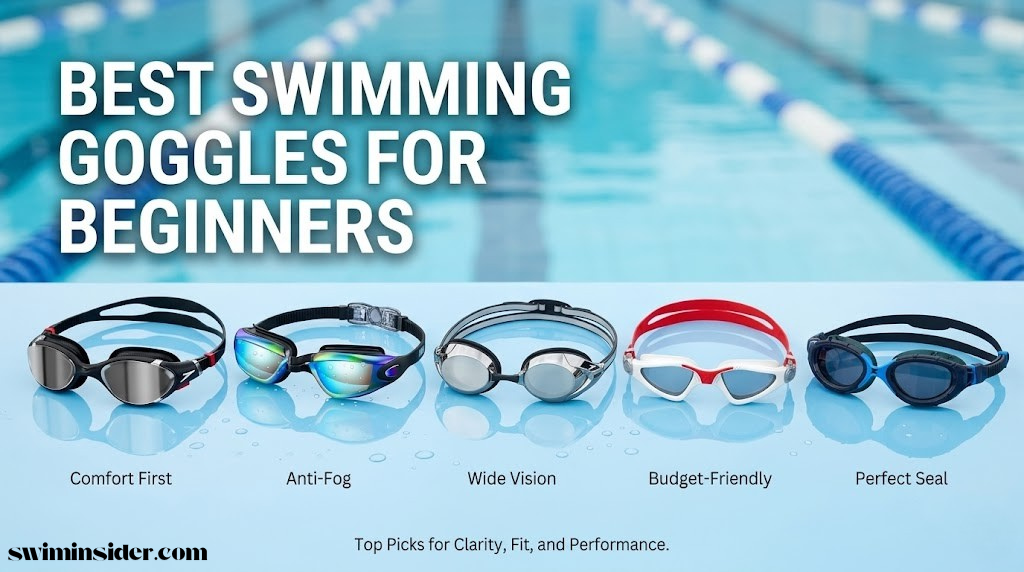
🏊 Our Top Picks at a Glance
- Best Overall: Speedo Biofuse 2.0 — soft seal, wide view, zero fuss
- Best Value: Aegend Swim Goggles — solid anti-fog for the price
- Best Wide-View: Speedo Vanquisher 2.0 — pool-proven optical clarity
- Best Comfort Seal: Aqua Sphere Kayenne — cushioned gasket, adult fit
- Best for Teens/Juniors: TYR Hydrosphere Jr. — youth sizing, great optics
- Best Premium Pick: Zoggs Predator Flex — titanium lens, next-level comfort
- Best Budget Mirror: Sporti Antifog S2 — mirrored lens under $15
Buying your first pair of swimming goggles shouldn’t be complicated — but walk into any sporting goods store and you’ll face a wall of options ranging from $8 to $80, with marketing promises that all blur together. Anti-fog. UV protection. Wide-angle. Hydrodynamic. What actually matters when you’re just starting out?
The answer is simpler than brands want you to believe. As a beginner, you need goggles that don’t leak, don’t fog, don’t hurt, and let you see clearly underwater. That’s it. The rest — polarized lenses, racing profiles, competitive gasket shapes — can wait until you’re training for your first triathlon or hitting serious yardage in the pool.
At Swim Insider, we’ve tested and reviewed dozens of goggle models across all experience levels. If you’re curious about the broader market, check out our full guide to the best swimming goggles overall — but if you’re brand new to the sport, read on. Every pick in this guide was selected with the beginner experience specifically in mind.
Why Beginners Need Different Goggles
It’s tempting to grab whatever the Olympic-looking swimmer is wearing in the lane next to you. But those sleek, low-profile racing goggles with tiny oval lenses? They’re built for competitors who have already dialed in their stroke, their flip turns, and their tolerance for a tight seal pressing into their eye sockets for 90 minutes straight.
For a beginner, that experience is miserable. Racing goggles often:
- Create significant pressure and leave red ring marks around the eyes after even 20 minutes in the pool
- Offer a narrow field of view, making it harder to navigate lanes and spot walls
- Require a very precise fit to seal correctly — even a millimeter off means leaking
- Have complex strap adjustment systems that take practice to set correctly
Beginner goggles prioritize the opposite: a wider, more forgiving seal, greater comfort over extended wear, easier adjustment, and a broader lens window so you can actually see where you’re going in the pool.
There’s also a learning curve to goggle fit itself. Knowing how tight to pull the strap, understanding how to seat the gasket correctly, and getting a feel for what “a good seal” feels like takes a session or two. Beginner-friendly goggles are designed to be forgiving during that learning process — they’re more likely to seal well even when your technique isn’t perfect yet.
Wondering how to get that fit right? Our dedicated guide on how tight swimming goggles should be walks you through it step by step.
The golden rule for beginners: Comfort wins. A pair of goggles you actually want to wear is infinitely more valuable than a technically superior pair that hurts after ten laps.
What to Look for When Buying Beginner Goggles
Before we dive into the specific picks, here’s a quick framework. When you’re evaluating any pair of goggles as a new swimmer, these are the five factors that should guide your decision:
1. Seal Comfort & Gasket Material
The gasket is the soft ring around the lens that presses against your face to create a watertight seal. For beginners, look for silicone gaskets — they’re softer, more pliable, and more forgiving than harder plastic. Some brands offer dual-layer or foam-backed gaskets for extra cushioning. Avoid hard plastic gaskets until you’ve built up face calluses (yes, that’s a thing).
2. Lens Style & Field of View
Larger lenses give you a wider field of view and feel less claustrophobic underwater. Curved or spherical lenses further expand peripheral vision. As a beginner, you want to be able to see walls, lane lines, and other swimmers clearly — a wide-view lens makes swimming less disorienting. You can learn more about the full landscape of goggle styles in our guide to how to choose swimming goggles.
3. Anti-Fog Coating
Every goggle ships with a factory anti-fog coating. The difference is how long that coating lasts and how effective it is to begin with. Better anti-fog coatings stay effective longer and reduce the need for after-market anti-fog sprays. Never wipe the inside of your lenses with a cloth — it removes the coating. Rinse only. For tips on keeping your goggles fog-free season after season, see our full guide on how to stop swimming goggles fogging.
4. Strap & Adjustment System
A split-strap or figure-eight strap design distributes pressure more evenly across the back of the head and reduces slippage. Easy-adjustment sliders let you dial in the fit quickly without taking the goggles off. As a beginner, you’ll be adjusting often — make sure the mechanism is intuitive.
5. Nose Bridge Fit
Many beginner-friendly goggles come with interchangeable nose bridges in multiple sizes, or a flexible unibrow design that stretches to fit different face shapes. Getting the nose bridge right is almost as important as the lens gasket — too short and the lenses press into your eyes, too long and the seal breaks at the inner corners.
Tip: Before you buy, do the suction test. Press the goggle cups to your eyes (without the strap) and hold for 2–3 seconds. If they stick to your face with mild suction, the shape is a good match for your orbital bones. No suction = likely leaker.
For swimmers who need prescription lenses, our guide to the best prescription swimming goggles covers your corrective options in detail.
The 7 Best Swimming Goggles for Beginners: Full Reviews

Speedo Biofuse 2.0 — Best Overall for Beginners
Editor’s ChoiceIf there’s one pair of goggles we’d confidently hand to a complete beginner with zero explanation needed, it’s the Speedo Biofuse 2.0. Speedo has spent decades refining what makes a recreational goggle work, and the Biofuse 2.0 is the culmination of that research applied to everyday swimmers.
The signature feature is the BioFuse technology gasket — a dual-material seal that pairs a flexible inner membrane with a structured outer frame. What this means in practice is a gasket that molds to the unique contours of your face rather than forcing your face to conform to the goggle’s shape. For swimmers with slightly asymmetrical faces (which is most of us), this is a game-changer. Leaking, the number-one frustration for beginners, becomes dramatically less common.
The lens itself is medium-sized — large enough for solid peripheral vision but not so bulky that it feels like you’re wearing a diving mask. The anti-fog coating is excellent out of the box and tends to hold up well through dozens of sessions when cared for properly. The UV400 protection makes these suitable for outdoor swimming too, giving you flexibility as you build confidence.
Strap adjustment is handled by a simple double-buckle system that’s easy to figure out even mid-swim. The nose bridge sits in the middle of beginner-friendly sizing — accommodating most adult face widths without additional pieces required.
✓ Pros
- BioFuse gasket dramatically reduces leaking
- Comfortable from the very first use
- Excellent anti-fog performance
- Works for pool and outdoor swimming
- Easy strap adjustment
✗ Cons
- Not the cheapest option at this quality
- Medium lens may feel small to some
- Nose bridge not interchangeable
Speedo Biofuse 2.0 — Unisex Adult Goggles
Check Price on Amazon →
Aegend Swim Goggles — Best Value for New Swimmers
Best Budget PickThe Aegend goggles punch well above their price class — which is exactly what a beginner on a budget needs to hear. You shouldn’t have to spend top dollar to start swimming, and Aegend has built their reputation on delivering reliable anti-fog performance and a solid seal at an accessible price point.
What separates the Aegend from the flood of generic discount goggles on the market is the quality of the lens coating and the thoughtful gasket design. The silicone seal is soft and well-shaped, sitting comfortably against the orbital bones without creating excessive pressure. The lens itself offers a wide field of view — notably wider than many goggles at this price — which is particularly valuable for beginners still getting used to navigating the pool underwater.
These are also marketed as triathlon-ready, which means they’re designed to be pulled on quickly (useful if you’re ever in an open water or competitive setting). For pool beginners, this translates to a straightforward, no-fuss setup process. The anti-fog coating performs well for the price, though expect it to degrade sooner than on premium models if you’re swimming frequently.
They also work very well as a first goggle for those curious about triathlon swimming — giving you room to grow into more demanding use cases without needing to upgrade immediately.
✓ Pros
- Outstanding value for the price
- Wide field of view lens
- Soft silicone gasket
- Anti-fog and UV protected
- Good for pool and open water
✗ Cons
- Anti-fog coating degrades faster than premium pairs
- Strap adjustment less refined
- Build feels slightly less durable
Aegend Swim Goggles — Anti-Fog, UV Protection
Check Price on Amazon →
Speedo Vanquisher 2.0 — Best for Optical Clarity
Top Clarity PickThe Speedo Vanquisher 2.0 occupies a fascinating middle ground: it’s a competitive-grade goggle in terms of optical clarity and lens quality, yet approachable enough in its fit and design to serve beginners who prioritize being able to see well in the pool above everything else.
The lens is the standout feature here. Speedo uses a wide-angle design with curved optics that significantly reduces distortion across the lens surface — especially at the edges, where cheaper goggles tend to blur. For beginners trying to count lane markings on the pool floor, track a flip-turn wall, or simply feel oriented underwater, this optical quality is genuinely helpful rather than a luxury detail.
The anti-fog performance is among the best we’ve tested at this price tier. The Vanquisher’s coating tends to last noticeably longer than budget options, holding its fog-resistance through dozens of sessions before any degradation. We’ve covered the Vanquisher in more depth in our dedicated Speedo Vanquisher 2.0 review — worth reading if you’re considering this as your first serious goggle.
The fit is slightly firmer than the Biofuse — the gasket is a more structured silicone that works better for certain face shapes. If you’ve done the suction test (mentioned earlier) and found it works for you, the Vanquisher’s clarity will be a genuine advantage in the pool.
✓ Pros
- Exceptional optical clarity
- Long-lasting anti-fog coating
- Wide-angle lens reduces disorientation
- Hydrodynamic profile
- Room to grow into lap swimming
✗ Cons
- Firmer gasket — less forgiving for some faces
- Slightly competitive feel may not suit casual swimmers
- Less cushioning than comfort-focused models
Speedo Vanquisher 2.0 — Anti-Fog, UV Protection
Check Price on Amazon →
Aqua Sphere Kayenne — Best Comfort Gasket
Most ComfortableAqua Sphere has carved out a distinct niche by building goggles that feel almost spa-like to wear in the pool, and the Kayenne is their flagship expression of that philosophy. If your primary concern is wearing goggles for extended sessions without any discomfort, this is your pair.
The defining feature is the curved lens design with a large, cushioned gasket. The wide-frame construction creates an unusually large field of view — closer to a mask than a racing goggle — and the soft gasket perimeter creates a seal without any pressure points. Many users with sensitive skin around the eyes, or those prone to headaches from standard goggles, find the Kayenne transformative.
The quick-fit buckle system is intuitive enough that you can adjust strap tension with one hand mid-swim without losing your place in a lane. The lens quality is solid — clear, well-coated, and UV-blocking — though not quite at the optical precision level of the Vanquisher. For a beginner, this distinction rarely matters in practice.
If you’ve found yourself avoiding swimming because goggles give you a headache or leave marks around your eyes, the Kayenne is the specific solution to that problem. It’s also excellent as an all-day comfort goggle for those who swim recreationally multiple times per week.
✓ Pros
- Unmatched long-wear comfort
- Massive field of view
- No pressure marks or headaches
- Intuitive one-hand strap adjustment
- Ideal for extended sessions
✗ Cons
- Bulkier profile than racing styles
- Slightly more drag in the water
- Not suitable for competition use
Aqua Sphere Kayenne — Adult Comfort Goggles
Check Price on Amazon →
TYR Hydrosphere Jr. — Best Beginner Goggle for Younger Swimmers
Top Junior PickTYR is a brand trusted by competitive swimmers at every level, and the Hydrosphere Jr. brings that heritage down to youth sizing without cutting corners on the features that matter most. If you’re buying goggles for a teen or pre-teen who is new to swimming — whether for lessons, a swim team, or recreational use — this is our confident top recommendation.
The junior fit is genuinely junior-sized, not simply a renamed adult goggle with a shorter strap. The lens placement, nose bridge width, and gasket circumference are all calibrated for younger, smaller faces — which is critical for achieving a proper seal. An adult goggle on a kid’s face almost never fits correctly, leading to constant leaking that makes learning to swim frustrating.
The anti-fog coating performs exceptionally well for the price point, the UV protection is robust (important for outdoor meets and lesson pools), and the silicone strap is comfortable even for kids with sensitive skin. The solid color lens options make it easy to customize for personality while still being pool-practical.
For even younger swimmers just getting started, we’ve also reviewed dedicated options in our guide to the best swimming goggles for kids and specifically for the youngest pool-goers.
✓ Pros
- Genuinely youth-sized for proper fit
- Strong anti-fog performance
- Comfortable silicone strap
- TYR’s reliable build quality
- Great price for junior segment
✗ Cons
- Not suitable for adult faces
- Limited lens color options
- Basic strap adjustment system
TYR LGHYBJR Hydrosphere Jr. Goggles
Check Price on Amazon →
Zoggs Predator Flex — Best Premium Beginner Goggle
Premium ChoiceIf you’re the type of beginner who wants to invest properly from day one — buying once, buying well — the Zoggs Predator Flex is worth every extra dollar. Zoggs is an Australian brand with deep roots in competitive swimming, and the Predator Flex represents their most sophisticated recreational-to-competitive crossover design.
The headline feature is the Flex frame technology: rather than a rigid goggle body, the Predator Flex uses a flexible frame that conforms to the unique contours of your face during the motion of swimming. As your head turns in the water, the frame flexes slightly with the movement, maintaining a consistent seal that rigid designs lose. For beginners who are still developing their stroke mechanics, this adaptability means fewer mid-swim leaks to interrupt your session.
The titanium-coated lens provides excellent scratch resistance and a premium optical experience. Mirrored coatings on certain colorways also reduce glare, making these suitable for both indoor and outdoor pool use. The anti-fog performance is class-leading — we’ve used pairs of these through months of regular swimming without significant degradation. Combined with the tips in our guide on how to clean swimming goggles, a quality pair like this can last years.
✓ Pros
- Flex frame adapts to face movement
- Premium titanium lens quality
- Class-leading anti-fog durability
- Works for pool and open water
- Long-lasting build
✗ Cons
- Higher price — overkill for casual beginners
- Mirrored lens not ideal for all indoor lighting
- Slightly complex adjustment system
Zoggs Predator Flex Goggles — Titanium Lens
Check Price on Amazon →
Sporti Antifog S2 Mirrored — Best Budget Pick with Mirror Lens
Budget ChampionNot every beginner wants to spend $30+ on their first pair of goggles — and that’s completely reasonable. Swimming is an experiment at first, and there’s no shame in wanting an affordable pair to test the waters (literally) before committing to a quality investment.
The Sporti Antifog S2 Mirrored is the best under-$15 goggle we’ve found for new swimmers. For the price, it delivers: a mirrored lens that works well for glare reduction in outdoor pools, a decent silicone gasket that seals reasonably well for most face shapes, and an anti-fog coating that performs adequately for casual swim sessions.
At this price tier, you accept certain compromises: the anti-fog coating will degrade faster, the strap adjustment is less refined, and the build quality won’t last as long as premium picks. But for a beginner who swims twice a week casually, or a parent buying a first pair for a child who may lose or damage it, the S2 Mirrored is an honest, capable option that won’t empty your wallet while you figure out what features you actually care about.
The mirrored lens is a fun feature too — it gives that classic competitive swimmer look while reducing squinting in bright pool lighting. For swimmers primarily in outdoor pools or those sensitive to glare, this is a genuinely useful feature even at the budget level. If glare reduction is important to you, also check out our roundup of the best polarized swimming goggles for a fuller view of options.
✓ Pros
- Exceptional value under $15
- Mirrored lens for glare reduction
- Anti-fog coating performs for price
- UV protection included
- Good for casual/occasional use
✗ Cons
- Anti-fog wears off faster
- Less durable build overall
- Not ideal for frequent or competitive swimming
Sporti Antifog S2 Mirrored Goggle
Check Price on Amazon →Quick Comparison: All 7 Beginner Goggles Side-by-Side
Use this table to compare the key specs at a glance. For deeper analysis of any pair, jump back to its full review above.
| Goggle | Best For | Gasket Type | Lens Style | Anti-Fog | UV | Price Tier |
|---|---|---|---|---|---|---|
| Speedo Biofuse 2.0 | Best Overall | BioFuse Silicone | Medium / Clear | Excellent | UV400 | Mid-Range |
| Aegend Swim Goggles | Best Value | Silicone | Wide / Tinted | Good | UV400 | Budget |
| Speedo Vanquisher 2.0 | Best Clarity | Silicone | Wide / Curved | Excellent | UV400 | Mid-Range |
| Aqua Sphere Kayenne | Best Comfort | Cushioned Silicone | Large / Curved | Very Good | UV400 | Mid-Range |
| TYR Hydrosphere Jr. | Best for Juniors | Youth Silicone | Junior / Clear | Very Good | UV400 | Budget-Mid |
| Zoggs Predator Flex | Best Premium | Flex Silicone | Large / Mirrored | Outstanding | UV400 | Premium |
| Sporti Antifog S2 | Best Budget | Silicone | Standard / Mirrored | Adequate | UV | Budget |
Types of Swimming Goggles: Which One Is Right for You?
Understanding the different categories helps you match your goggles to your actual swimming context rather than buying by brand name or price alone.
Recreational / Fitness Goggles
The category where all seven picks in this guide sit. These are designed for pool lap swimming, water fitness classes, and casual open water. They prioritize comfort, ease of use, and moderate optical quality over aerodynamic profile or competitive edge. The seal is typically softer and more forgiving, the lens larger, and the adjustment simpler. If you’re a beginner, you’re almost certainly in this category.
Racing / Competition Goggles
Slim, lightweight, and built for minimal drag. Racing goggles have a much smaller lens, a harder gasket, and a tight, precise fit that assumes the swimmer already knows exactly how to seat them. They can feel uncomfortable during warm-ups and become genuinely painful over long sessions for those unaccustomed to the design. Not suitable for beginners. If you’re curious what those look like in action, check out our guide to the best competitive swimming goggles.
Open Water Goggles
Designed for lake, ocean, and reservoir swimming, these typically feature tinted or polarized lenses to handle sunlight and surface glare, a wide field of view for navigation without pool lane lines, and a particularly robust seal to handle splashing and wave action. If you’re interested in this category, our open water swimming goggles guide covers it thoroughly.
Triathlon Goggles
A hybrid that combines open water features (tinted lens, robust seal) with a quick-release system for fast transitions. The Aegend in this list bridges into this category, which is why it’s marketed as triathlon-ready. Dedicated triathlon goggles are covered in our triathlon swimming goggles guide.
Prescription Goggles
For swimmers who need vision correction, prescription goggles use corrective optical-grade lenses instead of flat polycarbonate. If this applies to you, our prescription swimming goggles guide covers what you need to know, including how to match your diopter to available lens strengths.
How to Get the Perfect Goggle Fit: A Beginner’s Step-by-Step
The best goggles in the world become useless if they don’t fit your face correctly. Here’s how to dial in your fit — starting before you even get in the water.
Step 1 — The Suction Test (Before Buying)
Remove the strap and press each goggle cup against your eye socket. The cup should create mild suction and hold in place for 2–3 seconds when you pull your hand away. If it falls off immediately, the shape doesn’t match your orbital structure. If it hurts to press on, the gasket is too stiff or too small for your face.
Step 2 — Set the Nose Bridge First
For goggles with interchangeable nose bridges, try each size starting from the shortest. The cups should sit flat against your face with the nose bridge resting gently on — not pressing into — your nose. If the inner corners of the cups lift away from your face, the bridge is too short. If the cups press toward the center, it’s too long.
Step 3 — Put Them on Without the Strap
Place the cups against your eyes and hold them there with both hands. The gasket should create a light vacuum seal without you pushing hard. If you need to press firmly for suction, the gasket won’t maintain a seal through the movement of swimming.
Step 4 — Thread the Strap Behind Your Head
Position the strap mid-skull — not at the base of your head and not near the crown. The strap should sit horizontally. The center split-point (if your goggles have a split strap) should rest at the back-center of your head.
Step 5 — Adjust for Snug, Not Tight
Tighten the strap adjustment until the goggles stay on without pulling or slipping — then back off one notch. Most beginners over-tighten, which creates those red ring marks and headaches. The goggles shouldn’t move, but they also shouldn’t feel clamped. Check out our full guide on how tight swimming goggles should be for the detailed breakdown.
Step 6 — Test in the Water
Do a quick push-off and glide underwater. Move your head side to side and look up and down. The seal should hold through all these movements. If water trickles in at a specific corner, that’s where the fit needs adjusting — either the nose bridge needs sizing, or the strap needs slight repositioning.
Common mistake: Pulling the strap too tight over the top of your head rather than mid-skull causes the cups to rotate downward and the bottom seal to break. If you’re leaking at the bottom of the lens, lower the strap position first before tightening.
Persistent leaking even after a proper fit usually indicates one of three things: a face shape mismatch, a defective gasket, or technique issues. Our guide on why swimming goggles leak covers the full diagnostic process.
Anti-Fog Performance & How to Make Your Goggles Last
Foggy goggles are the beginner’s most common mid-swim complaint — and almost always avoidable. Understanding how anti-fog works changes how you treat your goggles and dramatically extends the life of the coating.
How the Anti-Fog Coating Works
Every new goggle ships with a hydrophilic (water-attracting) coating on the inside of the lens. This coating causes any moisture vapor that forms inside the goggle to spread into a thin, invisible film rather than beading into the scattered droplets that obstruct your vision. When the coating degrades — which happens gradually with wear — it loses this spreading ability and fogging returns.
The Single Biggest Mistake: Wiping the Inside
The inside of your goggle lens should never contact a cloth, finger, or any abrasive surface. Wiping even gently removes the anti-fog coating irreversibly. If your inside lens is dirty, rinse with clean cool water only, shake gently, and let air dry. That’s it.
Rinse After Every Swim
Chlorinated water degrades the anti-fog coating over time. After every swim, rinse your goggles in clean, cool tap water — not hot, which causes the silicone to degrade faster. Allow them to air dry in a shaded location away from direct sunlight, which UV-fades both the lens and the gasket material.
Store in a Case
Tossing your goggles loose into a swim bag causes the lens to scratch and the gasket to deform. Even a simple mesh bag or soft-shell case prevents the vast majority of preventable wear. The Speedo Biofuse and Zoggs Predator Flex both ship with protective cases — use them.
When to Use Anti-Fog Spray
Once your factory coating begins to degrade, a quality anti-fog spray applied to the inside of the lens before each swim can restore most of the original performance. Apply a small amount, let it sit for 30 seconds, then rinse lightly — not fully. Don’t wipe. Our full guide on stopping swimming goggles from fogging covers every method including the baby shampoo trick and spit technique (yes, really).
The best anti-fog performance doesn’t require special sprays — it just requires not wiping the inside lens and rinsing consistently. For deeper cleaning of the outside of the lens, gasket, and strap, our guide on how to clean swimming goggles has the full process.
Pool Swimming vs. Open Water: Do Beginners Need Different Goggles?
All seven picks in this guide are primarily designed for pool use — and that’s appropriate for most beginners. But if you’re learning to swim with an eye toward open water eventually (whether that’s a lake, the ocean, or a triathlon), it’s worth understanding the differences so you can plan your gear evolution.
What Changes in Open Water
Pool swimming happens in a controlled, chlorinated, indoor (or shaded outdoor) environment with a consistent, flat water surface and clear visibility. Open water introduces sun glare on the water surface, murky water, chop and wave motion, and — most significantly — bright sunlight directly overhead or low on the horizon.
Clear lenses, which work perfectly in pools, become problematic in open water because they let full sunlight through, causing squinting and temporary blindness when you sight toward the sun. Tinted or mirrored lenses filter that light, dramatically improving visibility and reducing eye fatigue.
The Mirrored Option: Sporti S2 as a Bridge
The Sporti Antifog S2 Mirrored, the last pick in our guide, actually serves as a reasonable bridge between pool and casual open water use — its mirrored lens handles surface glare better than clear models. For more serious open water, the dedicated picks in our open water swimming goggles guide offer darker tints and polarized options built specifically for that environment.
What Beginners Should Prioritize
If you’re in your first six months of swimming, stick with a clear or lightly tinted pool goggle. Master the fit, develop comfort with goggles in general, and understand what features matter to you — then make an informed second purchase for open water when the time comes. Buying specialized open water goggles before you’re comfortable in a pool is skipping a step that makes the transition harder, not easier.
If you’re gearing up for a triathlon specifically, the Aegend in this guide gives you a head start — its design philosophy anticipates open water use, making it a practical choice that doesn’t force a premature upgrade.
Buying Goggles for Children: What Parents Need to Know
The TYR Hydrosphere Jr. covers the junior/pre-teen demographic in our main list, but there’s a broader conversation worth having about goggles for younger children who are just starting swimming lessons or water play.
Why Sizing Matters Even More for Kids
Children’s face structures develop significantly between ages 3 and 12. A goggle that works beautifully for a 10-year-old will likely fit terribly on a 4-year-old, and vice versa. Most brands segment into “toddler” (ages 1–4), “junior” (ages 5–10), and “youth/teen” (ages 11–16) categories — though the naming isn’t standardized and varies by brand.
The consequences of a poorly fitted goggle for a child are the same as for an adult, just amplified: leaking that makes swimming unpleasant, pressure marks that cause crying, and a general association of swimming with discomfort that creates resistance to lessons. Getting the fit right matters enormously for a child’s willingness to keep showing up at the pool.
Features to Look for in Kids’ Goggles
- Soft, wide gaskets that are forgiving of imprecise fit during the learning curve
- Simple, easy-pull strap adjustment that kids can manage semi-independently
- Anti-fog coating — kids are in and out of the water constantly and rarely rinse their goggles properly, so a robust coating helps
- Bright colors and fun designs — kids are more likely to wear goggles they find cool or fun
- Durable construction — children are hard on their gear
Our dedicated guides to the best swimming goggles for kids and the best swimming goggles for toddlers cover the full range with age-specific picks. For toddlers in particular, the gasket size and fit tolerance requirements are quite different — don’t buy a product marketed as “kids” without confirming it specifies your child’s age group.
When to Buy New Goggles for a Growing Child
As a rough rule: if your child’s goggles have been through two swim seasons, or if they’re suddenly leaking despite proper strap adjustment, it’s time to reassess the fit. Children’s faces grow noticeably between seasons and what fit at the start of last summer may not fit correctly now.
Budget vs. Premium Goggles: Is It Worth Spending More?
This is genuinely one of the most common questions beginners ask — and the honest answer is: it depends on how often you swim and what problems you’re trying to solve.
| Price Tier | What You Get | Best For | Expected Lifespan |
|---|---|---|---|
| Under $15 | Basic anti-fog, silicone gasket, limited adjustment | Casual swimmers, testing the waters, kids prone to losing gear | 3–6 months of regular use |
| $15–$30 | Better anti-fog longevity, more comfortable gasket, wider lens options | Regular swimmers (2–3x/week), most beginners | 6–18 months |
| $30–$50 | Premium comfort, superior optical clarity, durable build, refined adjustment | Serious beginners, lap swimmers, those who value longevity | 1–3 years |
| $50+ | Competition-grade optics, specialized features (polarized, prescription, flex frames) | Competitive swimmers, triathletes, open water specialists | 2–4+ years |
The clearest argument for spending more is the anti-fog coating longevity. A $12 pair might fog after 20 sessions even with perfect care. A $35 pair from a reputable brand will often maintain coating effectiveness for 80–100+ sessions. If you swim three times a week, that’s the difference between replacing goggles twice a year or once every couple of years.
The second argument is comfort over time. Budget gaskets compress and harden with use. Premium silicone maintains its softness. After 40 hours in the pool, that difference becomes very noticeable.
The third argument is that comfort determines consistency. Swimmers who find their goggles uncomfortable avoid wearing them, swim fewer sessions, and progress more slowly. A $35 goggle that makes you want to be in the water is a better investment than a $10 goggle you dread putting on.
For beginners who aren’t sure how committed they’ll be to swimming: the Aegend (budget-mid) and Speedo Biofuse (mid-range) both represent ideal entry points. Neither will break the bank, and both will last long enough to tell you whether you want to invest further.
Also worth exploring for specific comfort needs: our guide to the most comfortable swimming goggles and for those with wider facial structures, our best swimming goggles for wide faces guide.
Frequently Asked Questions
-
What are the best swimming goggles for absolute beginners who have never swum before?
For a complete beginner, the Speedo Biofuse 2.0 is our top recommendation. Its BioFuse gasket technology is specifically designed to create a comfortable, leak-resistant seal even when your fit technique isn’t yet perfected — which is exactly the situation every new swimmer is in. If budget is a concern, the Aegend Swim Goggles offer the next best combination of comfort and value at a lower price point. The most important thing at the beginner stage is getting goggles that don’t leak and don’t hurt, so you can focus on learning to swim rather than fighting your gear.
-
How do I stop my swimming goggles from leaking?
Leaking is almost always a fit issue rather than a defect. Start by checking the nose bridge — if the inner corners of the goggle cups lift away from your face, the bridge is too short. Next, check your strap position — it should sit mid-skull horizontally, not at the base of your head. Many leaks at the bottom of the lens are caused by a strap that sits too high. If you’re still leaking after adjusting, the goggle shape may not match your face’s orbital structure. Do the suction test (press cups against your eyes without the strap) — if they don’t create mild suction, you need a different shape. For a full diagnostic guide, visit our article on why swimming goggles leak.
-
Are expensive swimming goggles really worth it for a beginner?
For most beginners, the sweet spot is the $20–$40 range — which covers goggles like the Speedo Biofuse 2.0, Speedo Vanquisher 2.0, and Aqua Sphere Kayenne. Below $15, anti-fog coatings degrade quickly and gasket quality drops noticeably. Above $50, you’re typically paying for features (polarized lenses, competition aerodynamics, specialized face-shape fitting) that a beginner simply doesn’t need yet. That said, if you know you’ll swim frequently and want to buy once, a premium pair like the Zoggs Predator Flex pays for itself in longevity and comfort over time.
-
How tight should swimming goggles be?
The most common beginner mistake is overtightening. Your goggles should create a light seal against your face with minimal strap tension — not a clamped grip. A good rule of thumb: tighten the strap until the goggles hold in place without shifting, then loosen one notch. You should feel gentle contact around the eye socket but no digging or throbbing. If your goggles leave red ring marks or cause a headache, they’re too tight. Our full guide on how tight swimming goggles should be walks through this in detail.
-
Why do my goggles fog up during swimming?
Fogging happens when the anti-fog coating on the inside lens surface has degraded enough that moisture condenses into droplets rather than a thin film. The most common cause of premature degradation is wiping the inside of the lens — even with a soft cloth, this removes the hydrophilic coating. Always rinse only with cool water and let air dry. For goggles where the coating has already worn off, an anti-fog spray can restore the effect before each swim session. Full guidance is in our anti-fog guide.
-
Can I use the same goggles for pool and open water swimming?
Clear-lens goggles (like most of the picks in this guide) work fine in indoor pools but struggle in outdoor or open water conditions because they don’t filter sunlight. If you plan to swim in open water or outdoor pools with direct sunlight, look for tinted or mirrored lenses — the Sporti S2 Mirrored in this guide handles casual outdoor use reasonably well. For dedicated open water swimming, a darker tint or polarized lens is significantly more comfortable. Our dedicated open water swimming goggles guide covers those options.
-
What goggle features matter most for beginner swimmers?
In priority order: (1) seal quality — do they actually prevent leaking on your face shape; (2) gasket comfort — do they stay comfortable for the duration of your sessions; (3) anti-fog performance — can you see clearly throughout the swim; (4) easy strap adjustment — can you adjust without frustration; (5) lens size — wider is generally more comfortable and less disorienting for new swimmers. Features like hydrodynamic profile, racing gasket design, and tinted lenses become relevant later as you develop. Start with the basics done well.
-
Do women need special swimming goggles?
Most swim goggles are unisex and fit the full range of adult face sizes. Some brands offer women’s-specific fits with a slightly smaller lens cup, adjusted nose bridge sizing, and occasionally narrower strap placement to account for differing head widths. If standard unisex goggles feel too large or the nose bridge feels too wide, a women’s-specific option may fit better. Our guide to the best swimming goggles for women covers the top picks across comfort, competitive, and open water categories.
-
How long do swimming goggles last?
A quality pair of goggles cared for properly typically lasts 12–24 months for regular swimmers. Budget goggles may last 4–8 months before the anti-fog coating is gone and the gasket starts hardening. The gasket is usually the first thing to fail — it hardens and cracks over time, causing leaking. The lens coating degrades next, leading to persistent fogging. If you rinse after every swim, store in a case, and never wipe the inside lens, you’ll be near the upper end of the lifespan range.
-
What’s the difference between swim goggles and diving goggles?
Swimming goggles and diving/snorkeling masks serve very different purposes. Swim goggles are designed to minimize water resistance (drag), cover only the eyes, and maintain a tight, low-profile seal suited for horizontal surface swimming. Diving masks cover both eyes and nose, are designed to equalize pressure during descent, and create significantly more drag — making them completely unsuitable for swimming laps or open water swimming. If you see anyone in a pool wearing a snorkel mask for recreational swimming, they’ll be working considerably harder than their goggle-wearing lane neighbors.
Conclusion: The Right First Goggle Changes Everything
Swimming is one of the most rewarding physical disciplines you can pick up as an adult or develop as a child — but only if you can actually see clearly, stay comfortable, and focus on technique rather than fighting leaking, fogging, or pressure pain. The right pair of beginner goggles makes that possible from your very first session.
Our overall recommendation remains the Speedo Biofuse 2.0 for most adult beginners — it’s the most likely to fit correctly on the first try, the most comfortable over extended sessions, and durable enough to last through the learning curve and well beyond. If budget matters, the Aegend delivers genuine quality for less. If comfort is your absolute priority, the Aqua Sphere Kayenne is in a class of its own. And if you’re buying for a younger swimmer, the TYR Hydrosphere Jr. is purpose-built for the junior face.
Remember: the best pair of goggles is the one you’ll actually wear consistently. Don’t overthink it. Pick one that fits the framework in this guide, get in the water, and give yourself the time to learn what matters to you personally. Your second pair of goggles — when you know exactly what you want — will be the truly informed decision. For now, just start swimming.
For a broader look at the market across all experience levels, our comprehensive hub at the best swimming goggles of all time covers every category from lap swimming to competitive racing. And if you want to go deeper on any aspect of goggle fit, care, or selection, the internal links throughout this article will take you exactly where you need to go.
Ready to Find Your Perfect Goggles?
Browse all seven of our top beginner picks on Amazon — with the Swim Insider affiliate tag to support our work at no extra cost to you.
Explore All Swim Insider Goggle Guides →