How to Swim Faster: 7 Technique Steps, Gear, and Training That Actually Work
Stop fighting the water. Learn the body position, stroke mechanics, and smart training that make you quicker without making you more exhausted.
Almost every swimmer hits the same wall. You swim more laps, you push harder, you finish out of breath, and your pace barely moves. The frustrating truth is that effort is rarely the missing ingredient. Water is roughly 800 times denser than air, and the resistance you feel grows dramatically as you speed up. Swimming faster is mostly a game of removing drag and applying force at the right moment, not of adding raw muscle.
This guide walks through seven concrete technique steps, each with a diagram, followed by the gear, training sets, and dryland work that lock those gains in. Whether you are a fitness swimmer trying to shave time off your mile, a triathlete working on open water efficiency, or a masters swimmer chasing a new personal best, you will find a clear order of operations here. If you are still working out what a realistic target looks like, our breakdown of how long it takes to swim a mile is a useful benchmark before you begin.
1. Why Speed Is About Drag, Not Muscle
Before touching a single drill, it helps to understand what you are actually trying to change. Your swimming speed is the result of two opposing forces: propulsion (what pushes you forward) and drag (what holds you back). Most intermediate swimmers spend years trying to increase propulsion by pulling harder, when the bigger prize is usually sitting on the drag side of the equation.
The three kinds of drag you can control
Form drag comes from your shape in the water. A sinking hip, a lifted head, or legs dangling beneath your torso all create a bigger frontal area to push through. Wave drag comes from the bow wave you create, which grows when you bounce, thrash, or lift your head to breathe. Frictional drag comes from the surface of your skin, suit, and cap against the water, which is why competitive swimmers pay attention to fabric and fit.
Because drag rises with the square of your speed, doubling your pace more than quadruples resistance. That is why a small improvement in streamline feels disproportionately large at race pace, and why sloppy technique gets punished the harder you try to go.
Speed equals stroke length times stroke rate
Every swimmer’s speed can be described by two numbers: how far you travel per stroke and how many strokes you take per minute. Beginners often increase one by sacrificing the other. They spin their arms faster but slip through the water with short, ineffective strokes. The goal is to lengthen each stroke first, then raise your tempo gradually without losing that length.
| Swimmer type | Typical pattern | Main fix |
|---|---|---|
| The Spinner | High tempo, short and slippery strokes | Lengthen the glide and improve the catch |
| The Glider | Long strokes with dead spots between pulls | Raise tempo and keep the lead arm active |
| The Sinker | Low hips, kicking hard to stay level | Press the chest, tighten the core, relax the head |
| The Lifter | Head high, wide breathing, loud splashes | Learn low, rotated breathing |
Take a moment to figure out which description fits you best. Film yourself if you can, even from the pool deck. Most swimmers are surprised by how different the footage looks from how the stroke feels. Keep that diagnosis in mind as you work through the steps below, because the order in which you prioritize them depends on your starting point.
Build your base kit for faster swimming sessions.
Shop Swim Training Gear on Amazon2. Fix Your Body Position
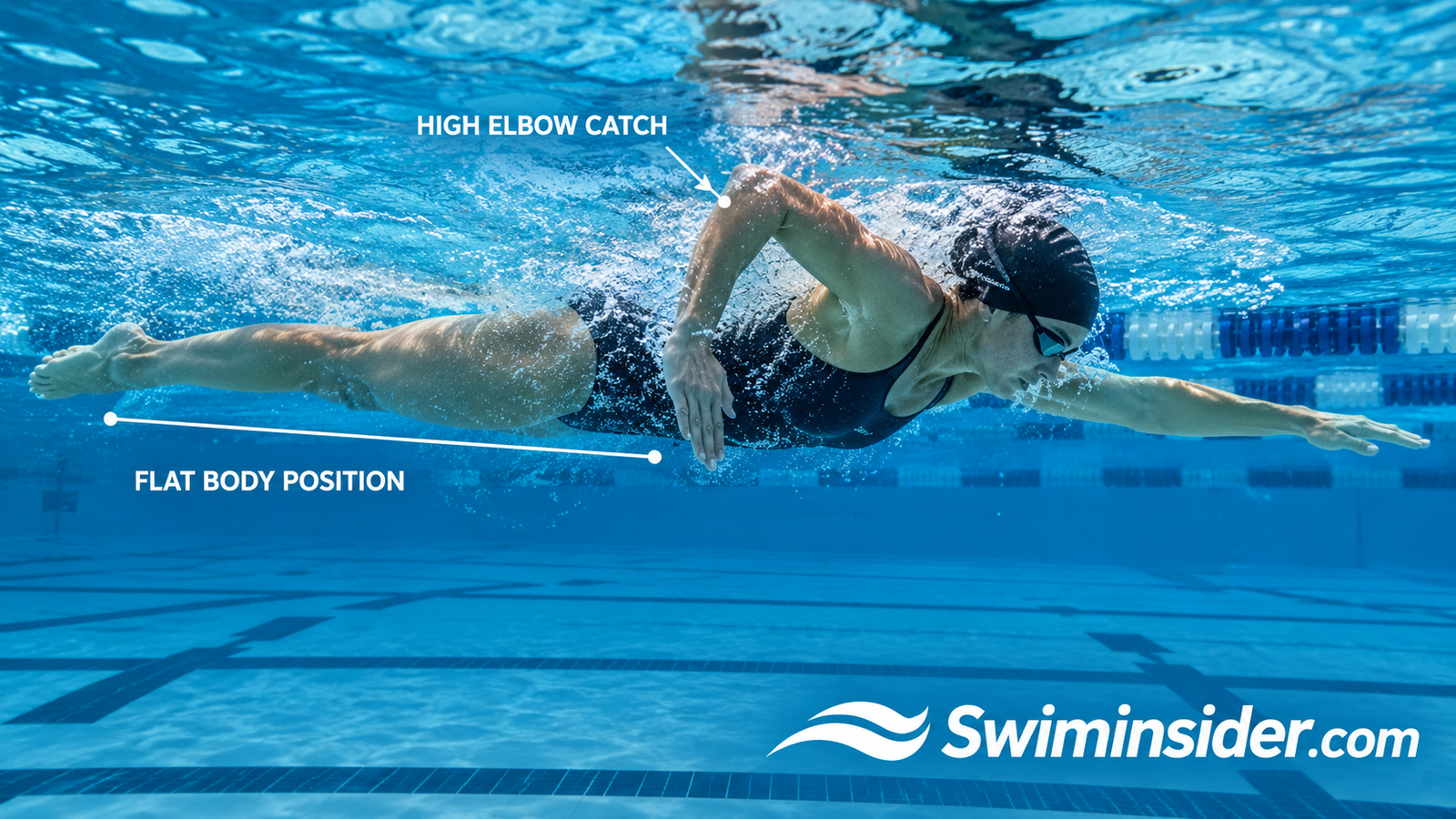
Body position is the foundation of every fast stroke. If your hips sink, no amount of arm power compensates, because you are dragging a bigger shape through the water. The ideal is a long, nearly horizontal line from the crown of your head through your hips to your toes, with the body riding slightly downhill like a seesaw balanced on your chest.
Press your chest down gently and the hips lift on their own.
How to find the right position
- Neutral head: Look at the bottom of the pool, slightly forward, so the water line sits around the crown or hairline. Lifting your chin drops your hips.
- Press the buoy: Imagine leaning on a beach ball under your chest. This lever raises the legs without extra kicking.
- Engage the core: A firm midsection stops the lower back from arching and the hips from sagging.
- Long neck, relaxed jaw: Tension in the neck travels straight down the spine.
Drills like front-position kick with a snorkel or fins make the balance feel obvious. If you often leave the pool with tight shoulders or a sore neck, there is a good chance your head position needs work. A pair of well-fitting goggles also matters here, because a swimmer fighting a leaky lens often lifts the head to clear it. If this sounds familiar, read why swimming goggles leak and how tight goggles should be so equipment problems stop disrupting your position.
A good snorkel and fins make position drills much easier.
Shop Fins and Snorkels on Amazon3. Master the Catch and Pull
The catch is the moment your hand and forearm grab the water and begin to move you forward. It is the single biggest propulsion skill in freestyle, and it is where most swimmers lose the most power. The classic error is a dropped elbow: the hand slides straight down while the elbow collapses, letting water slip past instead of pushing against it.
Elbow stays near the surface while the forearm and hand point down.
The early vertical forearm
After your hand enters and extends forward, let it settle slightly, then bend at the elbow so your fingertips point to the bottom of the pool while your elbow stays close to the surface. Your forearm becomes a wide paddle facing backward. Then drive that paddle toward your feet, keeping it close to your body line rather than sweeping out wide.
Pull through the hip, finish with the triceps
A strong pull travels along the body, ending with a firm push past the hip. Many swimmers rush the finish and exit the water early, giving up the last third of the stroke. Think “push the water to the wall behind you” until your thumb brushes your thigh.
Drills that build a better catch
- Fingertip drag: Skim your fingertips along the surface on recovery to keep the elbow high.
- Sculling: Small figure-eight motions with the hands out front train water feel.
- Fist drill: Swim with closed fists for a few lengths, then open your hands. The forearm learns to hold water, and the open hand feels huge.
- Single-arm freestyle: Exaggerate the early vertical forearm on one arm at a time.
Hand paddles can accelerate learning if used sparingly and with proper mechanics, but they stress the shoulders. Start small and treat them as a tool, not a crutch.
Add water-feel tools to sharpen your catch.
Shop Paddles and Pull Buoys on Amazon4. Rotate From Your Core
Flat, stiff swimming forces your small shoulder muscles to do all the work and creates a wide, draggy shape. Rotation lets the strong muscles of your back, lats, and core join the effort, and it narrows your profile so you slip through the water. The key is that rotation starts at the core, not the shoulders alone, and it moves around a steady spine axis.
Think of a skewer through the head and spine; the body rolls around it.
How much rotation is right?
Most efficient freestylers rotate somewhere around 35 to 45 degrees on each side. Less than that and your shoulders do too much; far more and you start swinging your hips and legs sideways, creating wiggle that wastes energy. The head remains calm, looking down, while the torso rolls beneath it.
Hip-driven timing
The rotation should be initiated as your opposite arm begins the catch. The hip drive helps push the pulling arm through the water, and the recovering shoulder rises out of the water so the arm swings forward with almost no effort. If your recovery feels like heavy lifting, you probably need more roll.
- Side kick drill: Kick on your side with the bottom arm extended and the head resting on the shoulder. Hold for six kicks, then switch sides with a stroke.
- 6-3-6 drill: Six kicks on one side, three strokes, six kicks on the other side. This trains smooth rotation and balance.
- Catch-up freestyle: One hand waits until the other finishes, building a long reach and a patient roll.
For triathletes and open water swimmers, rotation also makes sighting and breathing easier. If that is your world, gear matters too, so our guides to open water goggles and triathlon goggles are worth a look.
Make drill days easier with a kickboard and training fins.
Shop Kickboards on Amazon5. Build a Quiet, Efficient Kick
The freestyle kick has three jobs: keep your hips and legs high, balance the rotation, and add a bit of propulsion. It is not meant to be your engine. The legs are the largest muscles in the body, so a vigorous kick burns oxygen quickly, and for distance swimmers that is an expensive trade for very little speed.
Small, fast, and relaxed beats big and splashy.
Start at the hip, finish at the toe
Think of your leg as a whip. The motion begins in the hip flexors and glutes, travels through a softly bent knee, and ends with a floppy ankle. Stiff, pointed toes help, but ankle flexibility makes a bigger difference than most people realize. Swimmers with tight ankles often “reverse kick” and move backward when they push with the soles of their feet.
Match your kick to your distance
| Event type | Kick style | Notes |
|---|---|---|
| Sprints (50 m) | Six-beat, strong | Powerful and continuous |
| Middle distance | Six-beat, moderate or two-beat mix | Balance and rhythm |
| Long distance / open water | Two-beat or light six-beat | Save energy for the pull |
Strong kick pros
- Keeps hips high
- Boosts sprint speed
- Improves overall balance
Over-kicking cons
- Spikes heart rate fast
- Wastes oxygen
- Often breaks timing
Practice with fins to feel proper timing, then remove them and keep the same easy tempo. Short fins are especially good because they encourage a quick, compact kick rather than a slow, lazy one.
Short training fins build ankle flexibility and kick rhythm.
Shop Training Fins on Amazon6. Breathe Without Braking
Poor breathing is the most common reason swimmers slow down. When you lift your head, your hips drop, your legs sink, and your stroke falls apart for a beat. Efficient swimmers breathe with the body, turning the head only as far as the rotation allows, keeping one goggle in the water in the little trough created by the bow wave.
One goggle in, one goggle out, and the lead arm anchored forward.
Exhale underwater, inhale fast
Many swimmers hold their breath and then try to exhale and inhale at the same moment on the side. That is a recipe for panic. Instead, blow out gently through your nose and mouth the entire time your face is in the water, so that all you need to do on the side is open your mouth and take a quick, relaxed bite of air.
Bilateral breathing and rhythm
Breathing every three strokes balances your stroke and helps you see both sides, which is especially valuable in open water. Breathing every two or four strokes can be a good choice at higher intensities. Pick a pattern and stick with it rather than random gulping. If tolerance is a problem, build up with breathing every five strokes during easy sets so your lungs adapt.
- Bobbing: Practice rhythmic breathing in the shallow end to calm the nerves.
- Side kick with the face down: Rotate to the side to breathe for three kicks, then return.
- Three-stroke breathing sets: Alternate sides to eliminate a weak side.
Comfort is part of the equation. Clear, well-fitted goggles free you to focus on technique, and sealing issues often show up as fidgeting and head lifting. Skim our guide to the best nose clips for swimming if water up the nose bothers you, and look at ear plugs for swimmers to protect your ears. You may also want to read how to prevent swimmer’s ear if you train often.
Keep your nose and ears comfortable so you can focus on rhythm.
Shop Nose Clips and Ear Plugs on Amazon7. Nail Your Push-Offs and Streamline
Here is a secret that surprises many lap swimmers: a significant portion of every length is spent off the wall. In a 25-meter pool, a strong push-off and streamline can cover several meters faster than you can ever swim on the surface, because gliding below the surface avoids wave drag. If you improve your streamline, you gain free speed on every single turn.
Hold the streamline until you are about to drop below swimming speed.
Build the perfect streamline
- Lock the arms: Stack one hand on top of the other, squeeze your biceps against your ears, and keep elbows straight.
- Tuck the chin slightly: The head sits between your arms, not above them.
- Squeeze the core and legs: A long, rigid torpedo shape slips through the water.
- Point the toes: Eliminate drag at the tail end.
Add a kick, then break out smoothly
Once the push-off speed fades, add a small, quick kick, then pull and breathe into your first stroke with an easy rhythm. The ideal breakout happens when you are still slightly faster than your swimming pace. Break out too early and you lose the free speed; too late and you float through a dead spot.
Flip turns save time
A neat tumble turn keeps momentum and avoids the stop-start of an open turn. Practice tucking your chin, flipping tightly, and planting both feet at the wall with your knees bent. Most swimmers gain a surprising amount of time by perfecting turns alone.
If your goggles shift on the push-off, you are losing both time and confidence. Read how to choose swimming goggles and review the best swimming goggles for lap swimming for models that stay put at speed.
Goggles that stay sealed through every turn make streamlines stress-free.
Shop Racing Goggles on Amazon8. Dial In Stroke Rate and Tempo
Once your stroke is long and efficient, you can begin to adjust tempo. Stroke rate, the number of stroke cycles you complete per minute, determines how quickly you cycle through the pull. Because speed equals stroke length multiplied by stroke rate, a small increase in tempo can lead to a meaningful jump in pace as long as your stroke length does not collapse.
Your best pace lives between sluggish and frantic.
Use a tempo trainer or count strokes
A waterproof tempo trainer clips onto your cap or goggle strap and beeps at a set interval, giving you instant feedback. Without one, simply count your strokes per length and time yourself. If your stroke count stays steady while your time falls, your tempo is working. If the count creeps up quickly, you are slipping.
Swim golf for efficiency
Swim golf adds your stroke count to your time for a length. A lower score signals more efficiency. Track it over several weeks while changing one variable at a time, such as pushing off harder, lengthening your reach, or breathing more calmly.
| Goal | Adjust | Watch for |
|---|---|---|
| Easy aerobic swimming | Longer stroke, relaxed tempo | Smooth breathing |
| Threshold pace | Slightly quicker tempo | Stroke count staying steady |
| Sprint pace | Fast tempo, strong kick | Holding catch quality |
Your goggles matter at higher tempos too. Fogging and leaking break your focus right when you need it most, so check out our guides on how to stop goggles fogging and the best anti-fog swimming goggles.
A wearable tempo trainer or swim watch makes pacing visible.
Shop Tempo Trainers on Amazon9. Gear That Helps You Swim Faster
Technique is the engine, but the right gear removes friction, both literal and mental. No product will turn a flawed stroke into a great one, yet well-chosen equipment lets you train more comfortably, practice more precisely, and cut small amounts of drag that add up over a full race or workout.
Goggles
A leaky or fogging pair is a constant distraction, and a pair that sits poorly can pull your head out of position. Start with our overview of the best swimming goggles, then narrow down by use: competitive goggles for racing, beginner goggles if you are new, and polarized goggles for bright outdoor water. Fans of the brand can compare the best Speedo goggles, read the Speedo Vanquisher 2.0 review, or see how the Arena Cobra Ultra stacks up against Speedo Fastskin. Keep them in shape with our tips on how to clean swimming goggles.
Swimsuits
A snug, quick-drying suit reduces both frictional drag and the flapping of loose fabric. For serious racing, look at the best competitive swimsuits. For daily training, a durable suit made from chlorine-resistant fabric lasts longer. Browse the best swimsuits for men and best swimsuits for women to find something that fits close without restricting movement.
Swim caps
A cap smooths the head and hair, reduces drag, and keeps hair out of your face. See the best swim caps, the best swim caps for open water, and our silicone vs latex swim cap comparison to choose the right material.
| Gear | What it helps with | Best for |
|---|---|---|
| Low-profile goggles | Less drag, clear vision | Racing and fast sets |
| Training suit | Comfort and durability | Daily laps |
| Silicone cap | Smooth head, long wear | All-around use |
| Short fins | Kick rhythm, ankle range | Drill work |
| Pull buoy | Isolates the upper body | Pull sets |
| Paddles | Catch feedback | Advanced technique work |
| Tempo trainer | Pacing and rhythm | Stroke rate work |
Upgrade the three essentials: goggles, suit, and cap.
Shop Swim Essentials on Amazon10. Training Sets and a Weekly Plan
Technique is what you work on; training is how you make it permanent and build the fitness to sustain it. A good week mixes easy swimming, drills, threshold work, and a little speed. Too many swimmers repeat the same medium-hard effort every session, which builds neither efficiency nor top-end power.
A sample week for faster swimming
| Day | Focus | Sample session |
|---|---|---|
| Day 1 | Technique and aerobic base | Warm-up, drill-swim sets (catch and rotation), steady 100s with short rest |
| Day 2 | Rest or dryland | Mobility and core strength |
| Day 3 | Threshold | Repeat 100s at a strong but controlled pace with brief rest |
| Day 4 | Easy or rest | Light swim, kick sets, streamline practice |
| Day 5 | Speed and turns | Short sprints, push-off practice, 25s fast with full rest |
| Day 6 | Endurance | Longer continuous swim focusing on stroke count |
| Day 7 | Rest | Recovery |
Key set types
- Descending sets: Each repeat gets slightly faster than the one before, teaching pace control.
- Negative splits: Swim the second half of a distance faster than the first.
- Interval sets: Fixed repeats on a pace clock, such as 10 x 100 with controlled rest, build threshold fitness.
- Broken swims: Add a few seconds of rest mid-swim to practice race pace with better quality.
- Sprint sets: Short, all-out efforts with generous rest train power and turnover.
Rest is part of the plan
Adaptation happens while you recover. If your shoulders feel tired or your pace gets slower despite more laps, an extra rest day will usually do more than another hard session. Listen to small warning signs like shoulder aches early.
If you are building from a lower starting point, work through our beginner picks like the best beginner swimming goggles and keep your first goal simple: swim continuously with relaxed breathing before adding speed.
Track sets, laps, and pace automatically with a swim-ready watch.
Shop Swim Watches on Amazon11. Dryland Strength and Mobility
The pool is not the only place to get faster. A short, consistent dryland routine builds the posture, shoulder stability, and core strength that support every stroke. It also reduces the injury risk that comes from repeating the same motion thousands of times per week.
Core stability
A strong core holds your body line in the water. Planks, side planks, dead bugs, and hollow holds all mimic the tight streamline position. Aim for quality rather than long holds that collapse the lower back.
Shoulder and upper back strength
Rows, band pull-aparts, face pulls, and scapular push-ups strengthen the muscles that stabilize the shoulder blade. Pull-ups and lat pulldowns target the muscles that power the pull. Include rotator cuff exercises with light bands to keep the shoulders healthy.
Hips, glutes, and legs
Bridges, squats, lunges, and single-leg deadlifts build the strength behind a stable kick and powerful wall push-offs. Jump squats and box jumps can help sprinters develop explosive starts and turns.
Mobility that pays off in the water
- Ankle flexibility: Kneel with your toes pointed back and gently sit toward your heels.
- Thoracic spine rotation: Open-book stretches improve rotation.
- Shoulder flexibility: Doorway and wall slides help you reach long overhead.
- Hip flexors: Lunge stretches keep the hips from tightening on a desk-heavy day.
Benefits of dryland work
- Stronger streamline
- Fewer shoulder issues
- More powerful push-offs
Watch-outs
- Too much heavy lifting can cause stiffness
- Skipping mobility limits range
- Poor form builds bad habits
Two or three short sessions per week is plenty. Pair them with a stretching routine after swimming, when your muscles are warm. If you have an existing injury or pain, speak with a physical therapist or coach before adding new exercises.
Resistance bands and a yoga mat make dryland work easy at home.
Shop Resistance Bands on Amazon12. Common Mistakes and Tracking Progress
Even motivated swimmers repeat the same handful of errors for years. Spotting them early saves you months of frustration. Use the table below as a self-check, then record a quick video every few weeks to compare.
| Mistake | Why it slows you | Quick fix |
|---|---|---|
| Head too high | Drops the hips, adds drag | Look down and slightly forward |
| Crossing over at entry | Creates snaking and wobble | Enter in line with the shoulder |
| Dropped elbow | Water slips past the arm | Fingertip drag and sculling drills |
| Over-kicking | Burns oxygen for little speed | Smaller, quicker kick |
| Holding your breath | Causes panic and gasping | Exhale steadily underwater |
| Rushing the finish | Gives up the last bit of pull | Push to the thigh |
| Ignoring turns | Gives away free speed | Practice push-offs and flip turns |
| Always swimming the same pace | Limits fitness gains | Mix easy, threshold, and sprint sets |
How to measure improvement
- Timed benchmark: Choose a distance like 400 meters and test it every four to six weeks under similar conditions.
- Stroke count: Record the number of strokes per length at easy and fast pace.
- Swim golf score: Time plus strokes for a length. Lower is better.
- Video review: Compare body position, entry, and rotation across sessions.
- Feel: Track perceived effort. If the same pace feels easier, you have improved.
Open water and triathlon note
In open water, sighting, drafting, and navigating chop matter as much as raw speed. Practice lifting the eyes briefly forward without dropping your legs, and choose goggles with a clear field of view. For lakes with glare, polarized or tinted lenses help, and a bright cap makes you visible to safety crews.
Finally, be patient. Technique changes feel awkward at first, and speed often dips before it improves. Pick one focus per session, repeat it consistently for a few weeks, and let each step build on the one before it.
Ready to put it all together? Grab the gear that supports your next personal best.
Shop Faster Swimming Gear on AmazonFrequently Asked Questions About Swimming Faster
1. How can I swim faster without getting tired?
Focus on efficiency first. Keep your head neutral, hips high, and stroke long, and avoid over-kicking. Breathe out steadily underwater so you are not gasping. Most fatigue comes from drag and poor breathing, not weak muscles, so fixing technique often feels like getting free speed.
2. What is the fastest way to improve my freestyle speed?
Work on body position and the catch before anything else. Add streamline push-offs, since they give free speed on every length. Then train with structured intervals so you can hold the improved stroke at faster paces.
3. How long does it take to swim faster?
Most swimmers notice better feel and smoother strokes within a few weeks of focused drill work. Meaningful time drops usually take two or three months of consistent practice. Progress is faster for beginners and slower for experienced swimmers, so be patient and track benchmarks.
4. Is stroke rate or stroke length more important?
Both matter, because speed is the product of the two. Lengthen your stroke first, then gradually raise your tempo without losing that length. The best pace usually sits at a balanced sweet spot rather than at the extremes.
5. Does kicking harder make me swim faster?
Only to a point. A strong kick helps sprinters and keeps hips high, but over-kicking burns oxygen quickly. For longer swims, a lighter, steady kick that supports balance is usually more efficient.
6. Why do my legs sink when I swim?
Sinking legs usually come from a lifted head, a weak core, or a lack of chest pressure. Look down, press your chest toward the bottom, and engage your midsection. Practice with fins or a snorkel to feel the balanced position.
7. Should I use fins and paddles to swim faster?
They can help when used sparingly. Short fins build kick rhythm and ankle range, while paddles give feedback on the catch. Overuse can stress the shoulders or hide flaws, so treat them as short tools, not a permanent crutch.
8. Do swimsuits and caps really make a difference?
They make a small but real difference. A snug suit and a smooth cap reduce drag and distractions. Comfort matters too, because gear that fits well lets you focus on technique. Competitive swimmers choose carefully; fitness swimmers will benefit from a good fit more than a high price.
9. How often should I swim to get faster?
Three to five sessions per week works well for most people, mixing easy, threshold, and speed work. Quality matters more than quantity, and rest days are part of the process. Add dryland sessions if you can.
10. How can I improve my breathing while swimming?
Exhale continuously underwater so you only need to inhale on the side. Rotate with your body instead of lifting your head, and keep one goggle in the water. Practice bilateral breathing every three strokes to balance your stroke.
11. Can dryland exercises help me swim faster?
Yes. Core stability, shoulder strength, and mobility all support a better streamline and stronger pull. Two or three short sessions per week are enough. Include mobility work for ankles and thoracic spine for extra benefit.
12. What is a good mile time for a recreational swimmer?
It varies widely with experience and age. Many fitness swimmers complete a mile in roughly 30 to 45 minutes, and faster swimmers go well below that. Use your own benchmark and aim for steady improvement rather than comparing yourself to others.
Conclusion: Swim Smarter, Then Swim Harder
Swimming faster is a puzzle with a clear solution: reduce drag, apply force at the right time, and train with purpose. Start by flattening your body line, then improve your catch, rotate from the core, keep your kick quiet, and breathe without braking. Add streamlined push-offs, find your ideal tempo, and let a smart weekly plan and a little dryland work make those gains permanent.
Pick one step to focus on this week, film yourself, and track your progress. Small, repeatable improvements stack up quickly in the water, and before long, the same effort will carry you noticeably further and faster. Add the right goggles, suit, and cap, and you will remove the little distractions that hold you back.
Gear up for your fastest swims yet.
Shop Swimming Gear on Amazon
Pingback: How Long Does It Take to Swim a Mile? Times by Level